
How to Deduplicate Contacts: A Step-by-Step Guide to a Cleaner Address Book

Key Takeaways
- Duplicate contacts almost always come from four sources: multi-account syncing, import drift, manual entry, and platform migration.
- Always back up your contact list as a CSV or vCard before you merge anything — it’s your only safe rollback point.
- Manual cleanup works for lists under 200 contacts; anything larger needs an automated tool that asks before merging.
- Merge strategically by trusting your most recent source, then standardize phone numbers, company names, and email formatting once duplicates are gone.
- Prevent future duplicates by choosing a single source of truth for each contact type and running periodic deduplication scans.
- Contacts+ handles every step in one place: cross-account backup, side-by-side duplicate detection, safe, field-by-field merging with full undo history, and background scans that automatically catch new duplicates.
If you’ve ever scrolled through your address book and seen “Sarah Johnson” listed three times, once with her work email, once with her cell number, and once with the nickname you saved her under five years ago, you already know the problem. Duplicate contacts aren’t just a cosmetic annoyance. They cause missed messages, awkward double-texts, broken email merges, and the slow, creeping suspicion that your contact list is no longer something you can trust.
The good news is that deduplicating contacts isn’t difficult. It’s just rarely taught. Most people inherit a messy contact list from years of syncing accounts across iPhones, Androids, Gmail, Outlook, LinkedIn imports, and old SIM cards, and they assume there’s no way out but to start over. There is. This guide walks through exactly how to deduplicate contacts, what causes duplicates in the first place, how to identify them, how to merge them safely, and how to prevent them from coming back.
Why You End Up With Duplicate Contacts
Before you clean anything up, it helps to understand where duplicates come from. Almost every duplicate falls into one of four categories.
The first is multi-account syncing. When you connect Gmail, iCloud, Outlook, and a work directory to the same phone, each one pushes its own version of “Sarah Johnson” to your device. None of them know about the others, so you end up with three Sarahs that look almost, but not quite, identical.
The second is import drift. Every time you import a CSV, sync a CRM, or pull contacts from LinkedIn, you create a new layer. Names get formatted differently (“Sarah Johnson” vs. “Johnson, Sarah”), companies get abbreviated (“Acme Inc.” vs. “Acme Incorporated”), and phone numbers show up with different formatting (+1 555-123-4567 vs. 5551234567). Your software sees these as different people.
The third is manual entry. You meet someone at a conference, save their info, then receive their email signature later and save it again without realizing.
The fourth is platform migration. Switching phones or email providers almost always doubles your contact count.
Recognizing these patterns matters because each one calls for a slightly different cleanup approach.
Step 1: Back Up Your Contacts Before You Touch Anything
This is the step everyone skips, and everyone regrets. Before you merge a single record, export your full contact list as a CSV or vCard file and save it somewhere safe. If you make a mistake during deduplication, and most people do, you’ll want a clean rollback point.
In Contacts+, this is one click from your settings panel. In Google Contacts, you go to “Export” and choose vCard or Google CSV. In iCloud, select all contacts, then use the gear icon to export a vCard. Whatever you use, do this first.
Step 2: Identify Your Duplicates
Now you can start finding duplicates. There are two ways to do this: manually or automatically.
Manual deduplication works for small contact lists (under 200 contacts), where you can scroll through and spot obvious repeats. It’s tedious but precise. You’ll catch duplicates that automated tools miss, like the contact you saved as “Mike from the gym” and the one saved as “Michael Reyes.”
Automated deduplication is the only realistic option for anyone with more than a few hundred contacts. Contacts+ scans your entire address book and surfaces likely duplicates side by side, showing you exactly which fields match and which differ. You see the two records together, names, phone numbers, emails, companies, notes, and decide whether they’re the same person before merging.
This is where most generic deduplication tools fall short. They either auto-merge aggressively (and erase data you wanted to keep) or surface so many false positives that you give up halfway through. A good deduplication tool errs on the side of asking you to confirm.
Step 3: Merge Strategically
When you merge two contact records, you’re combining their fields. Most of the time, this is straightforward: both records have the same name, but one has a phone number, and the other doesn’t, so the merged record gets both. But sometimes the records conflict. One says the company is “Acme Inc.” and the other says “Acme Corp.” Which is right?
Here’s a rule of thumb: trust the most recent source. If you imported a contact from LinkedIn three weeks ago, that’s probably more current than the version you typed in manually four years ago. If you’re not sure, keep both values in the notes field so you don’t lose information.
Don’t be afraid to slow down. Merging the wrong two contacts, especially when they have similar names, creates a much bigger mess than the duplicates themselves. If a suggested merge looks even slightly off, skip it.
Step 4: Standardize What’s Left
Once your duplicates are merged, take an extra pass to standardize formatting. Phone numbers should all use the same format. Company names should match across contacts who work at the same place. Email addresses should be consistent (lowercase, no trailing spaces). This step is what separates a “deduplicated” list from a genuinely clean one.
Standardization also makes future deduplication easier. When all your formatting matches, the duplicate detector has a much easier time spotting actual duplicates and ignoring near-matches.
Step 5: Prevent Future Duplicates
The cleanup is only half the job. If you don’t change the habits that created duplicates in the first place, you’ll be back here in six months.
Pick one source of truth for each type of contact. Personal contacts live in one place. Work contacts live in another. Decide which account syncs to your phone and turn off the others. When you save a new contact, save it to the right account from the start.
Set up periodic deduplication reminders; once a quarter is plenty for most people. Contacts+ can run this scan automatically and notify you when new duplicates appear, so you catch them while there are 5, not 50.
How Contacts+ Deduplicates Contacts
Contacts+ is built around the idea that deduplication should be safe, transparent, and continuous, not a once-a-year panic project. Here’s how the platform handles each part of the process.
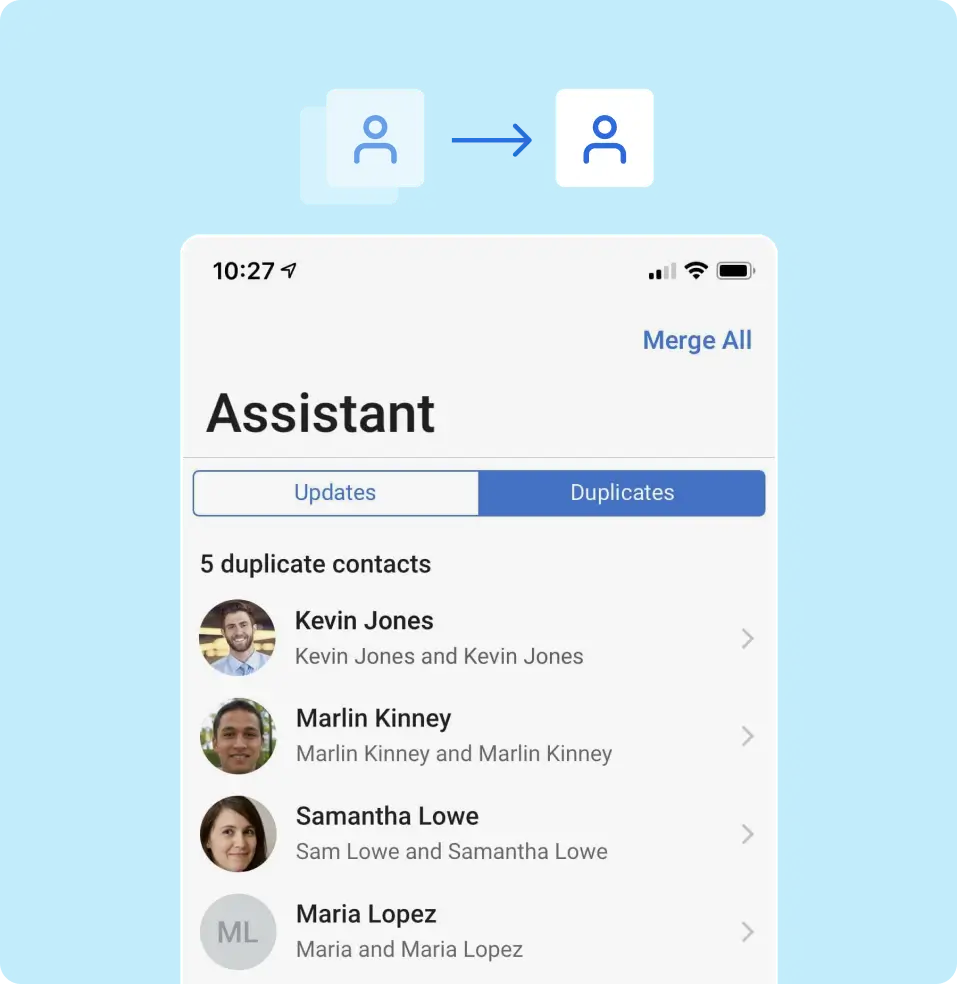
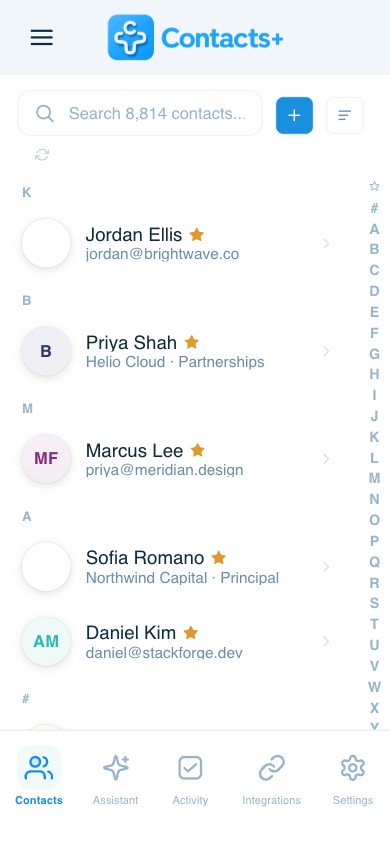
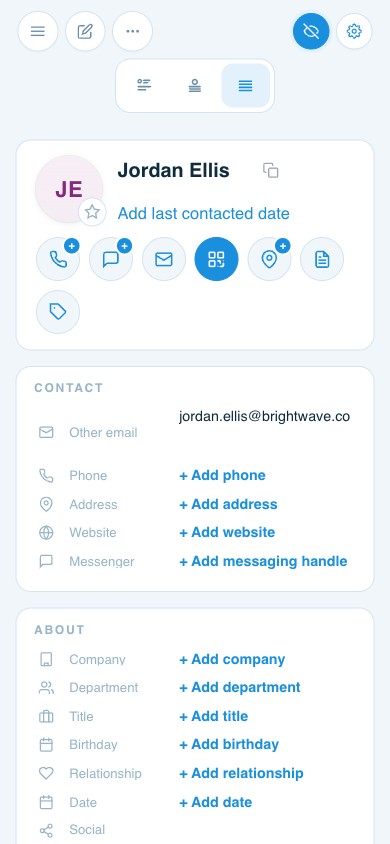
Quickly find and merge duplicate contacts with Contacts+ to keep your address book clean and organized.
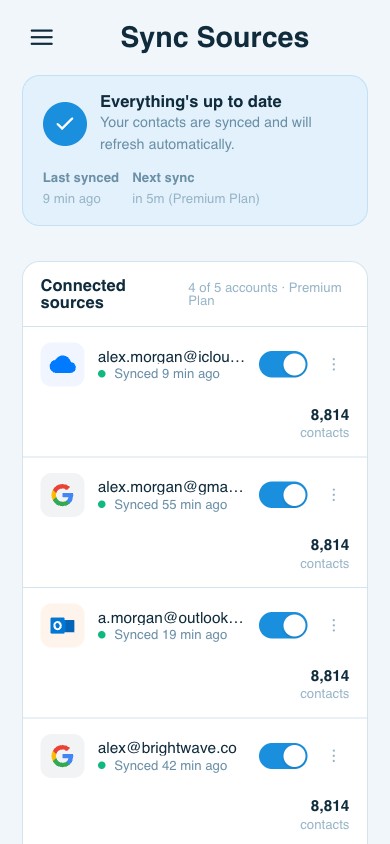
Unified view across every account. Contacts+ connects to Google, iCloud, Exchange, Outlook, and other major providers, then merges them into a single address book. That means duplicates are detected across accounts, not just within a single account. You won’t fix the same Sarah Johnson three times.
Smart duplicate detection. Rather than relying on exact-match logic, Contacts+ uses fuzzy matching to surface contacts that are likely to be the same person, even when names, phone formats, or company spellings differ. You’ll catch “Michael Reyes” paired with “Mike Reyes” or “+1 (555) 123-4567” paired with “5551234567.”
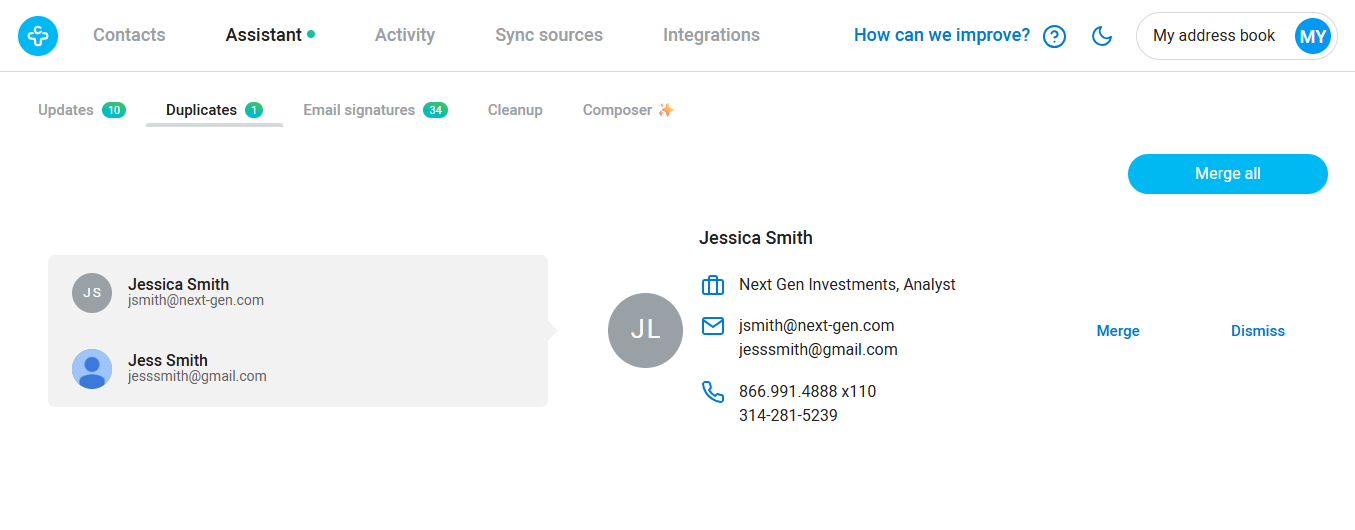
Side-by-side review before any merge. Every potential duplicate appears in a comparison view that highlights which fields match and which differ. You decide whether to merge, skip, or mark as “not a duplicate” so the same pair doesn’t keep resurfacing.
Field-level merging that preserves data. When you merge, Contacts+ combines unique values from both records rather than overwriting one with the other. If two records have different phone numbers, both are kept. If both have a notes field, the contents are preserved together.
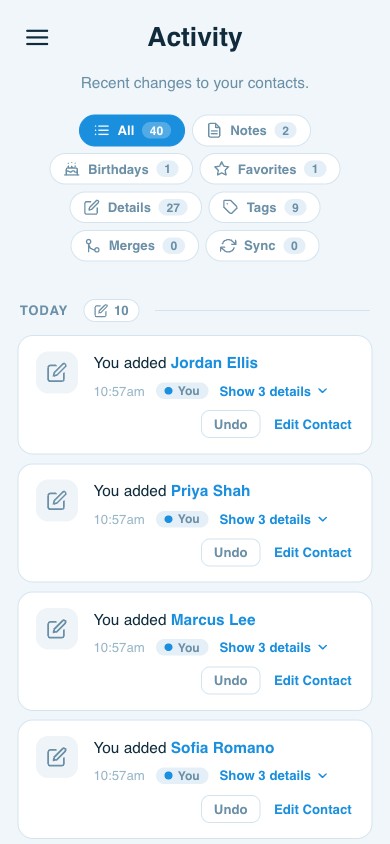
Full merge history and one-click undo. Every merge is logged and reversible, so a mistake is never permanent. This is the safety net most native contact apps don’t offer.
Background deduplication. Once your initial cleanup is done, Contacts+ keeps scanning quietly in the background and surfaces new duplicates as they appear, whether from a fresh sync, a CSV import, or a manual entry. You handle them in batches of five rather than letting them snowball into a massive cleanup project.
Cross-device consistency. Because Contacts+ works on the web, iOS, and Android, the cleanup you perform on your laptop syncs across all devices. Your phone’s address book benefits from the same deduplication logic without you having to redo the work on a smaller screen.
The result is an address book that stays clean on its own. You do the deep cleanup once, and Contacts+ keeps it that way.
Duplicate contacts come from syncing multiple accounts, importing data, manual entry, and migrating between devices. The fix has five steps: back up first; identify duplicates using an automated tool that asks before merging; merge strategically by trusting your most recent sources; standardize formatting once duplicates are gone; and pick one source of truth per contact type to prevent the problem from recurring. With Contacts+, you can do all of this in one place, including ongoing background deduplication so you never have to do a massive cleanup again.
Frequently Asked Questions
How long does it take to deduplicate a contact list?
For a list of 500–1,000 contacts using an automated tool, plan for 20–40 minutes. Larger lists (5,000+) can take an hour or more if you review each merge. Manual deduplication of even a few hundred contacts can take an entire afternoon.
Will I lose data when I merge contacts?
Not if you use a tool that combines fields rather than overwriting them. Contacts+ preserves all unique data from both records during a merge. Tools that auto-merge without asking are more likely to lose information.
Can I undo a merge if I make a mistake?
This depends on the tool. Contacts+ keeps a history so you can reverse merges. Native phone contact apps usually do not, which is why it’s essential to export a backup before you start.
How often should I deduplicate my contacts?
For most people, a quarterly check is enough. If you import contacts frequently or sync multiple accounts, monthly is better. Automated background scanning means you can essentially never think about it again.
Why does my phone keep creating duplicates after I clean them up?
Almost always because you have multiple accounts (iCloud, Google, Exchange, etc.) syncing the same contacts to your device. Each account stores its own copy. Pick one as your primary and disable contact sync for the others to stop the cycle.
Related articles

How to Merge Duplicate Contacts on iPhone (The Easy Way)
9 Ways to Clean Up Your Google Contacts

How a Mobile CRM Gives You an Edge
Put your contacts to work
Sync, enrich, and clean your entire address book with ContactsPlus — free to start.
Sign up free ← Back to all articles