
7 Ways AI Is Transforming Sales

AI tools now do real work in sales and marketing — scoring leads, forecasting revenue, segmenting audiences, drafting outreach. Almost all of that work reads from the same place: the contact records a team already has.
Here are seven ways AI has changed the sales industry — and what sales professionals have to get right underneath it:
1. Optimized Pricing
AI allows businesses to strategically set prices and adapt to changing market conditions. These tools help companies set profitable yet affordable prices to help increase sales.
AI tools can analyze significant amounts of data, like historical sales records, customer behavior, market trends, and competitor pricing. This analysis helps businesses understand how price changes affect sales, customer preferences, and market dynamics.
AI also facilitates the implementation of dynamic pricing, which automatically adjusts prices in real-time. These adjustments are based on various factors such as demand, inventory levels, time of day, and competitor pricing. Dynamic pricing is an excellent way to set competitive prices that help maximize revenue.
Aside from setting competitive prices that consider real-life data, AI can also help businesses stage effective promotions. AI tools help determine the best timing and discount level for these events to attract more customers without sacrificing profitability.
2. Lead Generation
AI can efficiently evaluate vast amounts of information from different sources, including social media, websites, and databases, to identify potential leads. This data analysis can uncover valuable insights about prospects and their interests.
Upon identifying potential leads, AI can assign scores to these prospects based on their likelihood of converting into customers. This process allows sales professionals to prioritize leads and allocate their resources accordingly.
Aside from identifying and prioritizing prospects, AI can help lead nurturing efforts. AI tools can create detailed customer profiles by collecting and analyzing data on their behaviors, preferences, and demographics.
This information helps sales and marketing teams tailor their messaging and implement effective outreach and marketing strategies. For example, if you’re using AI for real estate sales, you can receive recommendations on how to best interact with prospects in a specific area.
3. Upselling and Cross-Selling
One way AI helps in upselling and cross-selling is through customer segmentation. AI can segment customers based on their past purchase history, preferences, and behavior. Businesses can recommend relevant products or services to upsell and cross-sell by understanding each customer’s needs and interests.
While upselling and cross-selling strategies can help increase revenue, the same approaches might not work for all customers. AI tools can help analyze customer behavior to determine which clients and customers will respond best to these offers.
4. Customer Engagement
AI can help enhance engagement through chatbots and virtual assistants. These AI-powered technologies can communicate with customers in real-time. They help answer questions, provide information, and guide customers through the sales process.
They can also help with routine customer service queries. As a result, human agents can have more time to prioritize more complex tasks and customer issues. This assistance can improve response times and customer satisfaction.
Aside from providing adequate support and responses in one-on-one interactions, AI can also help with content curation for your company website and social media profiles. They can help determine the best photos, videos, and other content to attract customers.
AI can customize website content in real-time based on user behavior, ensuring customers see the most relevant information and products. This customized and responsive content helps increase engagement and time spent on the website.
On social media, AI can help in monitoring brand mentions, customer comments, and direct messages. This empowers you or your social media managers to respond promptly. It may even lead you to discover user-generated content you can integrate into your marketing campaigns.
5. Sales Forecasting
Sales forecasting is the process of estimating your company’s future revenue. This process can be tedious if done manually, especially since you need to consider factors like past performance and current market conditions.
AI makes this process much easier for sales professionals and business owners. AI systems can process and evaluate vast chunks of historical sales data. They also consider information from related sources such as market trends, customer behavior, and economic indicators.
Based on this analysis, AI uses predictive algorithms to forecast prospective sales based on historical data. These algorithms consider factors like the time of year, trends, and external events that may impact sales. They can also consider customer preferences, competitors, and market conditions to predict the demand for your products and services.
6. Coaching and Management
AI can analyze sales team performance data, such as call volume, lead conversion rates, and revenue generated. This analysis helps identify team members’ strengths and weaknesses. Managers can then use this data to set realistic goals and track progress.
After these assessments, AI can also help craft personalized training plans for sales representatives to improve their weaker areas. AI tools can help managers better monitor their teams and develop essential skills to aid their sales practices and strategies.
7. Crafting Buyer Personas
Buyer personas are a critical part of any sales and marketing strategy. They offer a detailed profile of your company’s target audience. Instead of relying on stereotypes, you can use AI to analyze your current leads and customer base to craft buyer personas.
AI can gather and consolidate data from various sources, including CRM systems, social media, website analytics, and customer interactions. This data provides a comprehensive view of customer behavior and demographics.
The algorithm can create segments or groups of these people based on patterns it recognizes in each data set. These audience segments can then serve as the basis for your buyer personas.
The Part Nobody Mentions: AI Inherits Your Contact Data
Every use above — scoring, forecasting, segmentation, personas — reads from your contact records. That is where the promise usually breaks, and it breaks quietly, because a model will return a confident answer from bad data just as readily as from good data.
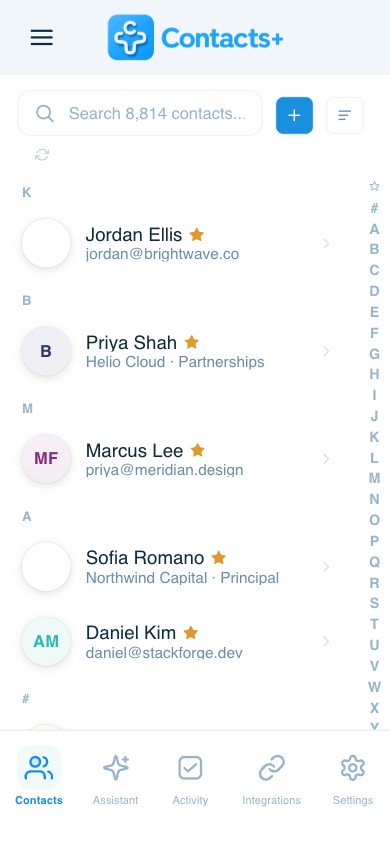
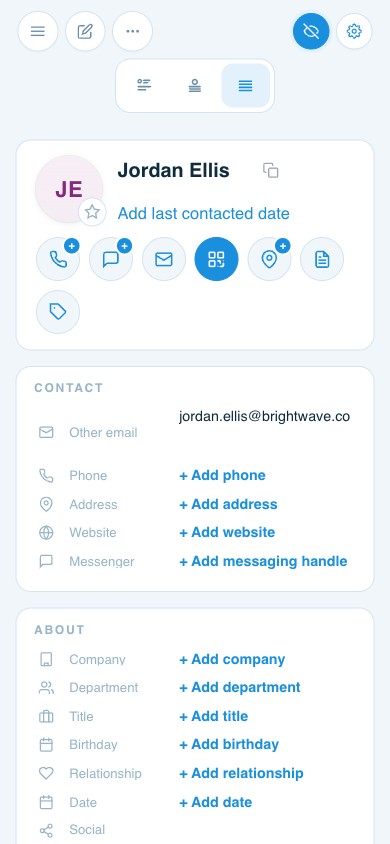
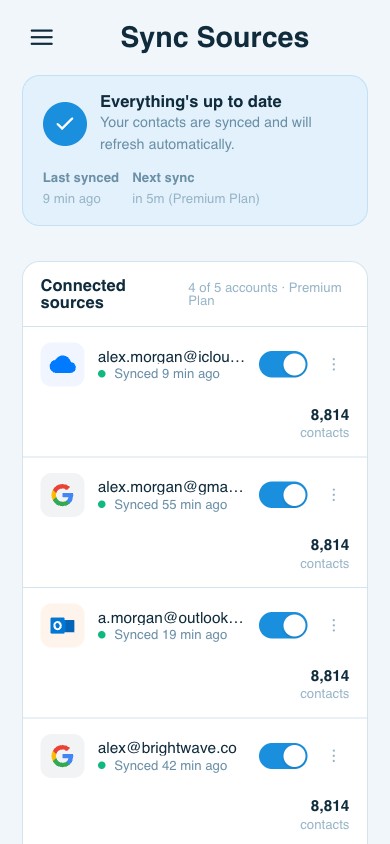
The first failure is fragmentation. Most sales teams keep contacts in more than one account: a Google work account, an iCloud account on the phone, an Outlook account inherited from a previous employer. The same buyer sits in all three, spelled slightly differently, with a different mobile number in each and the meeting history split between them. To a scoring model that is not one prospect with a rich history — it is three thin ones, none of which look worth calling. Deleting the extra copies inside a single account does not fix it either, because the next sync pulls them back from the others. Merging duplicates across every connected account at once is what turns those fragments back into one record worth reasoning about.
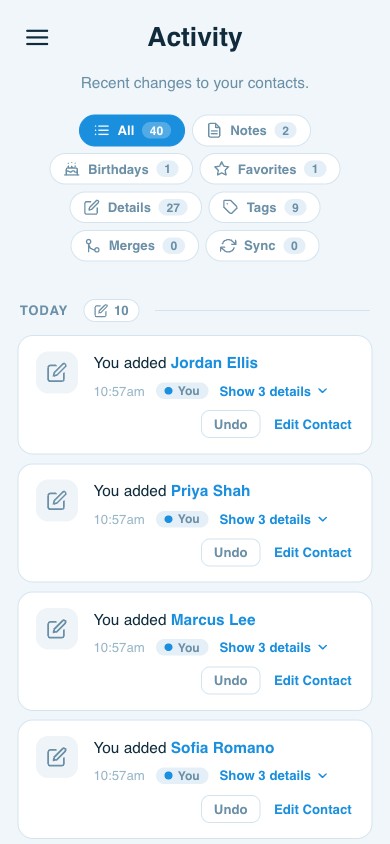
The second failure is decay. Titles change, people move companies, direct dials get reassigned. Buyer personas built from titles that are two years old describe an audience that has moved on, and a forecast weighted by an account owner who left in March is guessing. Keeping accounts in two-way sync, so a correction made on someone’s phone reaches every other account, is the difference between AI reasoning about your pipeline and AI reasoning about a stale snapshot of it.
A useful test before adding an AI layer: if a person could not tell which of your three records is the real buyer, a model cannot either.
AI Adoption for Sales Success
AI can price, prioritize, forecast, and personalize far better than a spreadsheet and a good memory ever did. But all seven uses sit downstream of the address book, which makes the highest-leverage AI project in most sales teams a distinctly unglamorous one: get to a single clean, current record per person, and the tools you already pay for start giving better answers.
Related articles

What Should Your Call Log Look Like?

Smart Calendar Integration: Let AI Suggest the Best Times to Reconnect
Put your contacts to work
Sync, enrich, and clean your entire address book with ContactsPlus — free to start.
Sign up free ← Back to all articles