
AI Contact Management in 2026: What’s Changed Since 2023
Key Takeaways
- Features that were “emerging” in AI contact management in 2023, including automatic data enrichment, activity logging without manual entry, and smart follow-up suggestions, are now standard.
- Newer developments include AI that summarizes communication history, drafts outreach in your voice, and connects directly to AI assistants like ChatGPT and Claude.
- AI agents are going mainstream: 54% of sellers have already used them, and Gartner predicts agentic AI will resolve 80% of common customer service issues by 2029.
- Clean contact data is the foundation. High-performing sales teams are far more likely to prioritize data hygiene than underperformers.
- When evaluating tools in 2026, focus on how deeply AI is integrated, how well it connects to your other tools, and how much control it gives you, not simply whether AI features exist.
- Tools that account for human nuance in tone and communication style tend to hold up better than those that treat relationship management as a purely automated process.
When we first covered how AI was impacting contact management back in 2023, we were writing about a trend that was just getting started. AI-assisted contact management was new enough that it was worth explaining what it even meant. Automatically enriching contact records and suggesting follow-ups felt like a glimpse of the future.
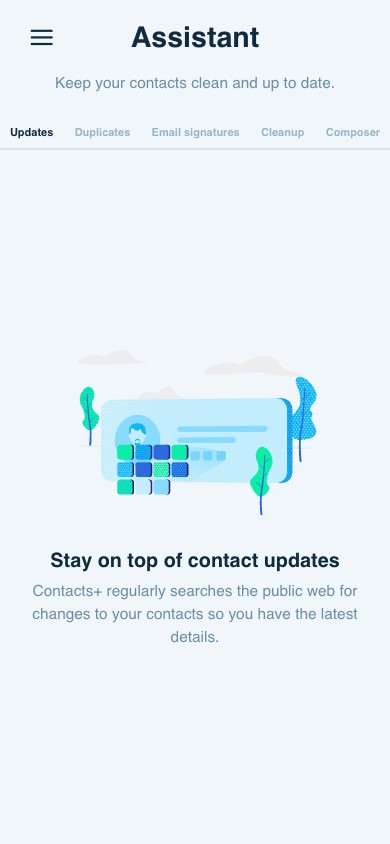
Three years later, that future is just… contact management. The features that seemed emerging in 2023 are now baseline expectations, and the conversation has moved on to what’s next. AI now reads your communication history, drafts your outreach, and can even work directly with the AI assistants you already use. Here’s an updated look at where things actually stand.
What Was “Emerging” in 2023 Is Now Standard
A few features that were highlighted as cutting-edge in 2023 are now things users simply expect from any contact management tool worth using:
- Automatic data enrichment. In 2023, having a tool automatically fill in missing details about a contact (company, job title, photo, social profiles) felt impressive. Today, it’s a baseline feature across most contact management and CRM tools, and its absence would be notable. Better tools also keep improving over time, so records stay current when people change jobs or titles.
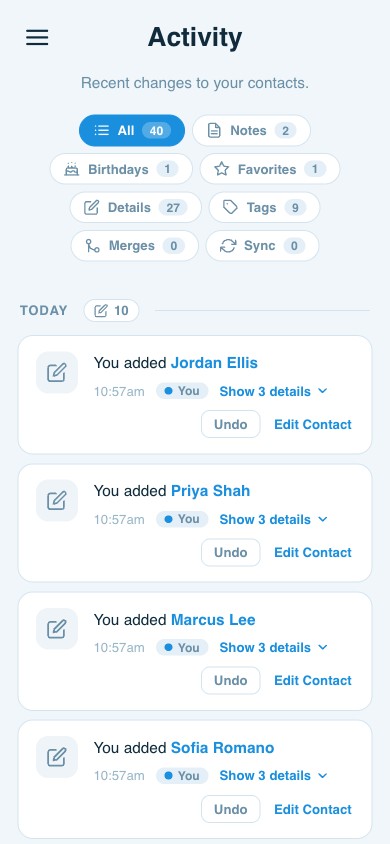
- Activity logging without manual entry. AI-native tools now automatically capture activities, contacts, and relationship updates from actual communications like emails, calls, and meetings. In 2023, this was framed as an emerging capability. In 2026, manual activity logging is increasingly seen as a sign of an outdated tool.
- Smart follow-up suggestions. Tools that nudge you to follow up with a contact based on time elapsed or relationship importance were a novelty in 2023. Now they’re a standard feature, often paired with AI-drafted message suggestions rather than just a reminder.
- Automatic cleanup. Duplicate detection and merging used to be a periodic chore. Now AI can spot duplicates across multiple accounts and imports, merge them into a single record, and keep a history of changes so nothing is lost.
What’s Actually New Since 2023
If the 2023 story was “AI can help organize your contacts,” the 2026 story is closer to “AI can understand your relationships and act on that understanding.” A few developments stand out:
AI that reads and summarizes communication history
Rather than just storing that you emailed someone, today’s tools can summarize what was discussed across an entire communication history, including emails, call transcripts, and messages. You get relationship context without scrolling through old threads.
Drafting outreach in your voice
AI-powered contact tools increasingly combine contact storage with models that draft outreach messages in your voice, based on how you’ve written to that person (or similar contacts) before. This goes well beyond the generic “suggested follow-up” templates of a few years ago.
Your AI assistant can work with your contacts
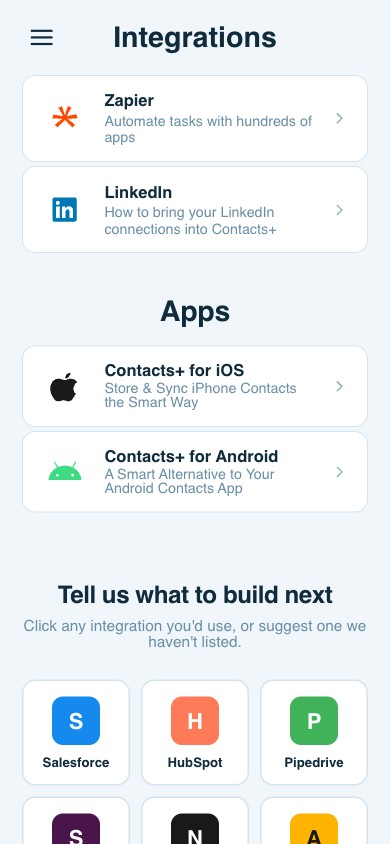
One of the biggest shifts is that contact management no longer lives only inside a contact app. Through connection standards like the Model Context Protocol (MCP), general-purpose AI assistants such as ChatGPT and Claude can now connect directly to a contact database. That means you can ask your assistant to look up a contact, pull context before a meeting, or draft a message, all using your real address book. ContactsPlus, for example, connects to AI assistants this way.
AI agents handling first-touch outreach
On the sales and marketing side, AI agents have moved from experimental to mainstream. Salesforce’s 2026 State of Sales report found that 54% of sellers have already used AI agents, and nearly 90% expect to by 2027. These agents often handle initial research and outreach based on data signals, with humans stepping in once a contact engages.
Autonomous resolution on the service side
Customer service is heading in the same direction. Gartner predicts that by 2029, agentic AI will resolve 80% of common customer service issues without human intervention. As more routine interactions become automated, the quality of the contact data behind them matters more than ever.
Why Clean Contact Data Matters More in the AI Era
Every AI feature described above depends on one thing: accurate contact data. An AI that drafts outreach can’t help if it’s working from an outdated job title. An agent that prioritizes follow-ups will make poor choices if half your records are duplicates.
The data backs this up. In the same Salesforce research, 79% of high-performing sales teams said they prioritize data hygiene, compared with 54% of underperformers. In other words, the teams getting the most out of AI are the ones that invested in clean, unified contact data first.
For small businesses and individuals, that usually means three things:
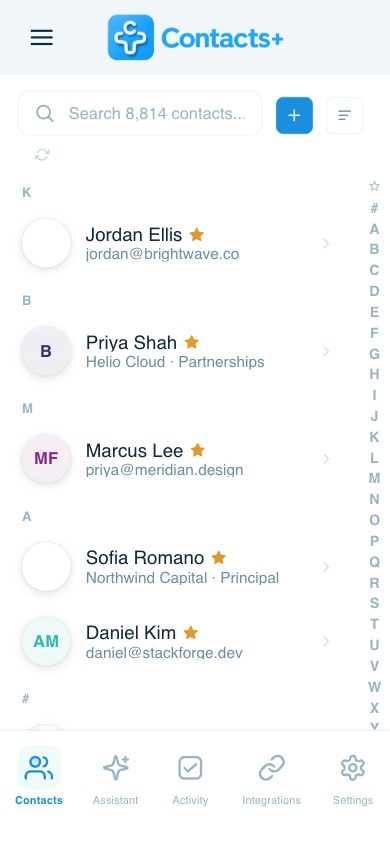
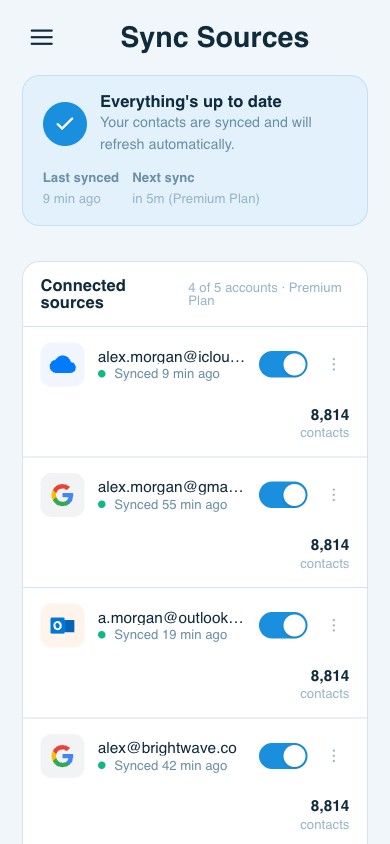
- One source of truth. Sync contacts from Google, iCloud, and Outlook into a single, unified address book instead of maintaining separate lists.
- Ongoing enrichment. Keep records updated automatically so details don’t go stale.
- Regular deduplication. Merge duplicate records so every AI tool sees one complete profile per person.
What This Means If You’re Choosing (or Re-Evaluating) a Tool
If you chose a contact management tool in 2023 based on whether it had “AI features,” that framing is largely outdated. Nearly every tool in this space now has some AI features. The more useful question in 2026 is how deeply AI is integrated, and what specifically it does for you.
A few things worth checking when evaluating a tool today:
- Automation: Do enrichment, deduplication, and activity logging happen automatically, or do they still require manual triggers or imports?
- Context: Can the tool summarize relationship history in a meaningful way, not just “you emailed this person 3 times” but what you actually discussed?
- Voice: Does AI-drafted outreach sound like you, or does it produce generic text that needs heavy editing?
- Connectivity: Can your contact data connect to the AI assistants and tools you already use, or is it locked inside one app?
- Control: Does the tool make decisions for you, or does it surface information and let you decide? Can you see and reverse changes AI makes to your records?
A Word on Human Nuance
One theme has become clear by 2026: tools that ignore human nuance (tone, temperament, personality, emotional context) tend to feel obsolete quickly, even if they’re technically sophisticated. A contact management tool that perfectly logs every interaction but drafts robotic outreach, or treats every contact identically regardless of relationship history, misses the point of what “relationship” management is supposed to be about.
The tools that have aged well since 2023 tend to use AI to support the relationship by surfacing context and reducing busywork, rather than trying to automate the relationship itself.
Looking Ahead
If the shift from 2023 to 2026 is any guide, the next few years will likely continue moving from “AI organizes information” toward “AI participates in relationships.” Expect AI to draft more communication, make more proactive suggestions, and handle more first-touch work in both personal and business contexts. Expect your contacts to travel with you, too, as more AI assistants connect directly to the data they need.
For most small businesses and individuals, the practical takeaway isn’t to chase every new AI feature. It’s to keep your contact data clean, unified, and accessible, and to periodically check whether your current tool’s AI capabilities still represent the baseline. Like the “emerging” features of 2023, today’s advanced features may quietly become tomorrow’s minimum expectation.
Frequently Asked Questions
Is it too late to start using AI-powered contact management if I haven’t yet?
Not at all. Since these features are now standard across most modern tools, adopting one today gives you immediate access to capabilities that took years to develop, without following a gradual rollout.
How do I know if my current contact management tool’s AI features are outdated?
Compare what your tool does automatically (enrichment, deduplication, logging, follow-up suggestions) against what’s described as standard here. If your tool still requires significant manual entry for things like activity logging or cleanup, it may be behind current expectations.
Can I use ChatGPT or Claude with my contacts?
Increasingly, yes. Some contact management tools now connect to AI assistants through the Model Context Protocol (MCP), so your assistant can look up contacts, pull context, and help draft messages using your actual address book. Check whether your tool supports this kind of integration and what permissions it requires.
Does AI-drafted outreach actually save time, or does it just create more editing work?
This varies significantly by tool and depends on how well the AI has learned your communication style. It’s worth testing with real contacts during a trial period rather than assuming based on marketing claims.
Are AI agents a good fit for small businesses, or mainly for large sales teams?
AI agents were initially adopted more by larger sales teams, but the underlying capability is increasingly available in tools aimed at smaller businesses too. Whether it’s a good fit depends on your contact volume and how personalized your outreach needs to be.
Why does data quality matter so much for AI?
AI tools can only work with the information they’re given. Duplicate records, outdated job titles, and scattered contact lists lead to irrelevant suggestions and awkward outreach. Keeping your contacts synced, enriched, and deduplicated is the single most effective way to get better results from any AI feature.
Will AI in contact management continue changing this quickly?
Based on the pace of change between 2023 and 2026, it’s reasonable to expect continued meaningful shifts. That’s why it’s good practice to revisit your tools and their capabilities periodically, rather than choosing once and assuming they stay current.
Related articles

Contact Management Is Becoming the New Productivity Stack


Creating Genuine Customer Experiences in the Digital Age
Put your contacts to work
Sync, enrich, and clean your entire address book with ContactsPlus — free to start.
Sign up free ← Back to all articles