
Managing Real Estate Contacts Across Multiple Markets Without Losing Your Mind

Key Takeaways
- Multi-market contact management doesn’t require a full CRM; it requires structure. A well-tagged contact system handles 90% of the job.
- Organize every contact along three dimensions: market (where they operate), role (what they do), and relationship stage (new, active, trusted, or avoid).
- Add deal-type tags (flip, BRRRR, buy-hold, STR, etc.) to filter contacts by both geography and strategy.
- Use notes for the one or two things you’ll want to remember next time, not as an interaction log. Keep it to two sentences max.
- Do a quarterly audit to keep tags accurate, reclassify stale relationships, and surface dormant contacts before you need them.
- With this system in Contacts+, you can find the right person for the right deal in the right market in seconds, without the overhead of a CRM you don’t really need.
The first time you close a deal in a new market, your contact list starts to feel different. The wholesaler you found in Phoenix is suddenly mixed in with the agent you trust in Tampa, the property manager you inherited in Atlanta, and the title officer in Cleveland who actually returns your calls. Every one of them is a real person with a real role in a real deal, but on your phone, they all just look like names.
For real estate investors expanding geographically, this is the moment when contact management becomes mandatory. You can’t remember which inspector covers which county. You can’t find the lender you used for that BRRRR in Indianapolis. You’re texting the wrong agent about the wrong property. The deals don’t stop coming, but the friction in every conversation keeps rising.
Most investors at this stage assume the answer is a full CRM or something with a hundred fields and a steep learning curve. For some people, that’s the right move. But for the much larger group of investors who just need to find the right person, in the right market, at the right time, a properly organized contact system handles 90% of the job. This post is about how to set that up in Contacts+ without the overhead of a full CRM.
Why Multi-Market Contact Lists Fall Apart
The reason your contact list breaks when you expand isn’t that you have too many contacts. It’s that the structure that worked for one market doesn’t scale to several.
When you operate in one market, you can keep everything in your head. You know who your three reliable contractors are. You know which agent works which neighborhood. You know your title rep’s voice when they call. The contact list is just a Rolodex, a place to look up phone numbers when you need them.
The moment you add a second market, your mental model collapses. Now you have two of every role, and the question is no longer “what’s their phone number” but “who’s the right person for this specific situation.” Your contact list needs to answer questions it was never designed to answer.
The fix is to add structure, but only the structure you actually need.
The Three Dimensions That Matter
Almost every multi-market real estate contact can be organized along three dimensions: market, role, and relationship stage. Get these three right, and you can pull up exactly the right person in seconds.
- Market is the geographic area where they operate. This might be a city (Phoenix), a metro area (Phoenix-Mesa-Scottsdale), or a specific submarket (West Valley). Pick the level of granularity that matches how you actually do deals. If you only operate in one part of a city, tag at the submarket level. If your team covers entire metros, tag at the metro level.
- Role is what they do. Wholesaler. Buyer’s agent. Listing agent. Lender. Hard money lender. Title officer. Contractor. Property manager. Inspector. Appraiser. Attorney. Accountant. Be specific. “Lender” is not enough. There’s a real difference between your conventional lender and your hard money lender, and you’ll want to filter for one without seeing the other.
- Relationship stage is how warm the connection is. New contact (you’ve talked once). Active (you’ve worked together on a current deal). Trusted (you’d recommend them without hesitation). Avoid (you’ve had a bad experience and don’t want to use them again). This last one is the secret weapon. Most investors never document who they don’t want to work with, so they end up rehiring the same problem contractor twice.
Setting It Up With Tags, Not Custom Fields
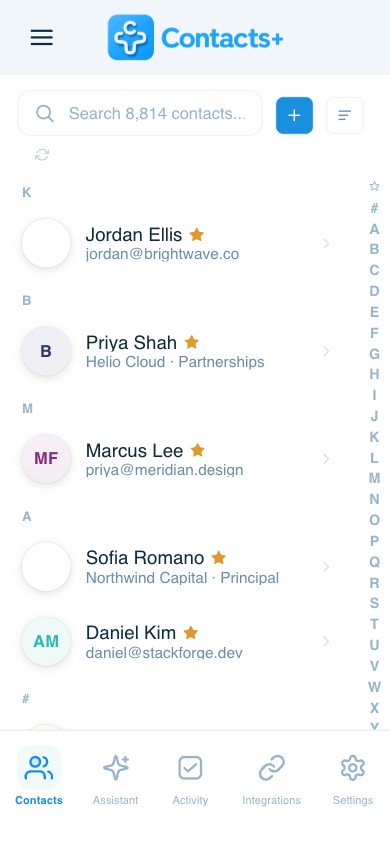
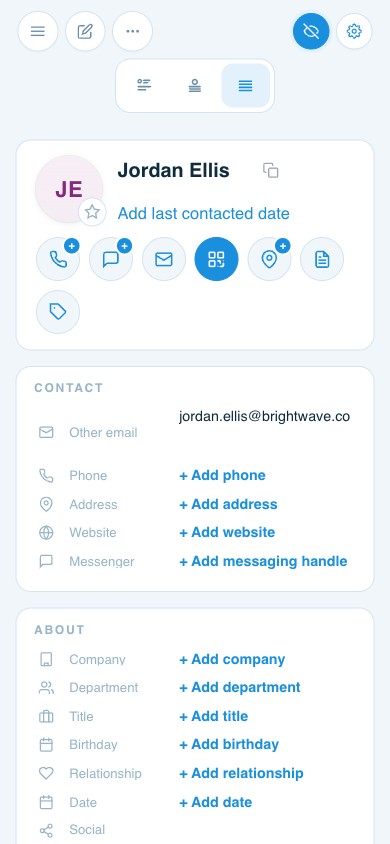
In Contacts+, tags are how you implement this structure. You don’t need a custom field for market; you just tag every Phoenix contact with “phoenix.” You don’t need a relationship pipeline; you just tag your trusted contacts with “trusted.” Tags are flexible, searchable, and they don’t require you to commit to a schema before you start.
A real estate contact in this system might end up with three to five tags: phoenix, west-valley, wholesaler, trusted, off-market-deals when you need to find a trusted off-market wholesaler in the West Valley, filter by those tags to get your shortlist.
The discipline is actually to apply the tags. Set aside fifteen minutes once a week to tag any new contacts you’ve added. If a contact doesn’t have at least a market tag and a role tag, it’s not really useful; it’s just a name.
How to Use Notes Without Building a CRM
Tags tell you who someone is. Notes tell you what you know about them. The trap is treating notes like a CRM, trying to log every interaction, every email, every meeting. You won’t keep up, and you’ll abandon it within a month.
The lighter approach: write notes that you will need in the future. After every meaningful interaction, ask yourself, “What do I want to remember about this person the next time I talk to them?” The answer is usually one or two sentences. “Prefers texts over calls. Charges 8% on hard money, can close in 10 days.” “Daughter starting at ASU in the fall. Likes to talk Cardinals football before getting down to business.” “Burned us on the inspection in Maryvale. Wait time three weeks, missed the foundation crack.”
These notes don’t need to be exhaustive. They just need to exist. The next time you call this person, six months from now, when you’ve had four hundred other conversations, those two sentences are the difference between a smooth call and an awkward one.
Organizing by Deal Type, Not Just Geography
Some contacts only matter for certain kinds of deals. Your hard money lender is irrelevant for a buy-and-hold rental but essential for a flip—your section 8 specialist matters for affordable rental strategies and not at all for short-term rentals.
Add deal-type tags alongside your market and role tags: flip, brrrr, buy-hold, str, wholesale, commercial. Now, when you’re underwriting a flip in Tampa, you can pull up flip-specific contacts in Tampa with two clicks. Without these tags, you’d have to mentally filter through everyone in Tampa to find the relevant ones.
The Quarterly Audit
Every quarter, spend an hour going through your tagged contacts and asking three questions. Are these tags still accurate? Have any “active” contacts gone cold and need to be reclassified? Are there contacts I haven’t talked to in a year that I should reach out to before I need them?
That last question is the one that pays off most. The lender you used two years ago, who would happily fund another deal, you’ve probably forgotten about them. A quarterly look at your contact list surfaces these dormant relationships before you actually need them, which is when you should be reactivating them anyway.
Multi-market real estate contact management doesn’t require a full CRM; it requires structure. Tag every contact with three dimensions: market, role, and relationship stage. Add deal-type tags to filter by strategy. Use notes for the one or two facts you’ll want to remember next time, not as an interaction log. Audit your tags quarterly to keep them current and surface dormant relationships. With this system in Contacts+, you can find the right contractor in the right market for the right deal in seconds, without the overhead of building and maintaining a CRM you don’t really need.
Frequently Asked Questions
Should I use a CRM or a contact manager for multi-market real estate investing?
If you have a team running deals through a defined pipeline, a CRM is worth the overhead. If you’re a solo investor or small team where deals don’t move through a standardized workflow, a tagged contact manager handles 90% of the job at a fraction of the complexity.
How many tags are too many?
There’s no hard limit, but if a contact has more than seven tags, you’re probably over-categorizing. Most contacts only need a market tag, a role tag, a relationship stage tag, and maybe one or two deal-type tags.
What about contacts who work in multiple markets?
Tag them with all the relevant markets. A wholesaler who covers Phoenix, Tucson, and Las Vegas gets all three tags. When you filter by market, they show up wherever they’re relevant.
How do I handle contacts I inherited from a partner or VA?
Treat them as new until you can verify them. Tag them with the market and role you think they belong to, then add a “needs-verification” tag. Confirm details next time you talk to them, and remove the verification tag once you have direct experience.
What’s the best way to share contacts with a team?
Use a shared workspace where everyone tags consistently. Agree on tag conventions up front, like “phoenix” not “PHX” and “wholesaler” not “wholesalers.” Inconsistent tagging is the main reason shared contact systems break down.
Related articles
From ContactsPlusKeep client, lead and referral contacts straight across marketsSee it for real estate →


Put your contacts to work
Sync, enrich, and clean your entire address book with ContactsPlus — free to start.
Sign up free ← Back to all articles