
How to Build a Contact System That Survives Employee Turnover

Key Takeaways
- A contact system survives employee turnover when it captures three layers of information: identity, relationship, and context.
- Notes need to be frictionless to add, or they won’t be added at all. Keep them short, written like voicemails for the next person.
- Use 10–15 high-value tags consistently rather than letting tag schemes sprawl.
- Centralize all relationship knowledge in a single tool so people don’t maintain parallel records.
- When someone gives notice, run an offboarding contact audit to capture what they know before they walk out the door.
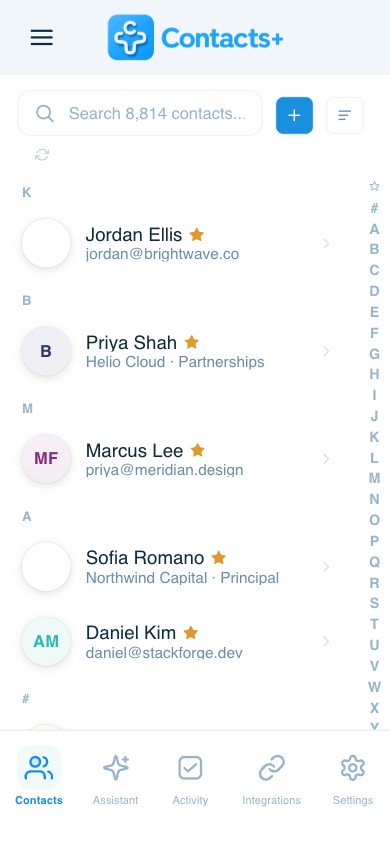
- With Contacts+, all of this lives in one searchable, shareable system that doesn’t depend on any single person to function.
When a salesperson resigns, an account manager moves on, or a long-tenured executive retires, something invisible walks out the door with them: the dozens of small details about every relationship they touched. The vendor’s preferred negotiating style. The fact that the client’s CFO is the real decision-maker, not the COO, whose name is on the contract. The reminder that this particular partner needs a check-in call before any project kickoff, or things will go sideways.
These details rarely live in a system. They live in someone’s head, and when that head is gone, you’re starting over with relationships that took years to build. Think of it as building a second brain for your relationships: a system that holds the context, history, and nuance that makes every connection actually useful.
For admins and operations leaders, the cost of this is enormous and almost entirely preventable. The fix isn’t a fancier CRM, more rigorous data entry mandates, or a culture change you can’t actually enforce. The fix is a contact system designed from the start to capture the kind of context that survives turnover. This post walks through how to build one.
The Real Problem Isn’t Missing Contacts
When someone leaves, the contact records themselves usually transfer fine. The names, the phone numbers, the company affiliations, all of that exports to a CSV and imports into the next person’s account without much trouble.
What doesn’t transfer is the context around those contacts. Why does this client only respond to emails sent before 9 AM? Why do we always loop in their general counsel before sending a proposal? What was the deal we lost three years ago, and what did we learn from it? Who are friends with whom inside their organization, and who shouldn’t be cc’d on what?
This context is what makes a relationship useful. Without it, the new owner of the relationship is starting from scratch, and the other end of the call can usually tell. As we’ve written about before, your contact list may be more incomplete than you think, and that gap compounds every time someone walks out the door.
The goal of a turnover-resistant contact system is to make this context visible, durable, and discoverable. That’s it. Every design decision flows from there.
The Three Layers Every Contact Record Needs
A contact record that survives turnover has three layers. The first is identity, like name, title, company, and contact details. Almost every system handles this well.
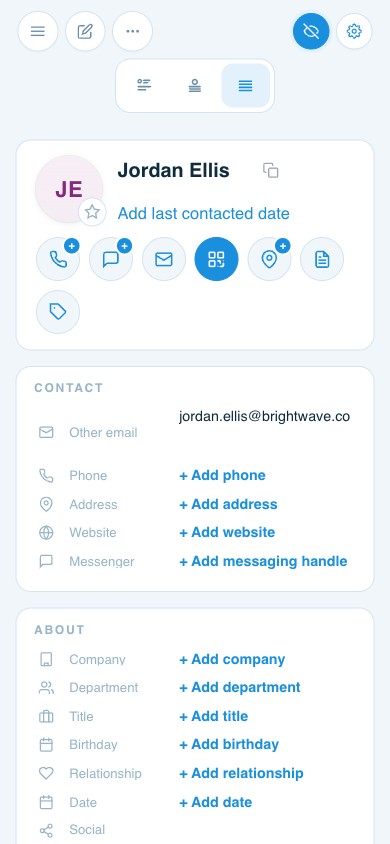
The second is the relationship. How does this person fit into your business? Are they a primary contact, a champion, an influencer, a gatekeeper? Have we worked with them before? What’s the current status of the relationship? This layer is where most systems start to thin out, because it requires people to fill in fields rather than just sync from email signatures.
The third is context. The unstructured knowledge that makes the relationship work. Communication preferences. Personal details that matter (kids’ names, alma mater, the trip they’re about to take). History of past interactions. Things to avoid. This is where almost every contact system fails. Either there’s no place to put this information, or there is, but no one fills it in.
A turnover-resistant system makes all three layers visible at a glance, and makes the third layer, context, as easy to add as a tweet.
Notes That Actually Get Used
The single biggest determinant of whether a contact system survives turnover is whether people actually write notes. And the single biggest determinant of whether people write notes is friction.
If adding a note requires opening a CRM, finding the contact, clicking edit, scrolling to the notes field, typing, and saving, people won’t do it. They’ll mean to. They’ll feel guilty about not doing it. They will not do it.
The threshold for a sustainable note habit is roughly: less than fifteen seconds and never out of context. That means notes need to be addable from wherever you already are — your phone after a call, your email client after a thread, your calendar after a meeting. It also means notes can be short. A two-word note (“hates Zoom”) is infinitely better than a beautifully formatted note that never gets written.
Train your team to write notes as if they were leaving a voicemail for the next person who’ll own this relationship. Not “had a good meeting today.” Instead: “She prefers to handle pricing herself. Don’t loop in her assistant on quotes.” Three sentences max. The next person will thank you. Better contact notes also have a direct downstream effect; meaningful contact management drives better email results across the board.
Tags That Survive Reorgs
Tags are the second pillar of a turnover-resistant contact system. They let you find a person even when you don’t remember their name, and they let a new employee navigate a contact list that was built by someone else.
The tags that matter most for institutional memory are those that capture relationship types and histories. “Champion” for someone who advocates for you internally. “Decision-maker” for someone who actually signs. “Renewal-risk” for someone whose contract is up and who hasn’t been engaging. “Past-customer” for someone who left and might come back. “Lost-deal” for an opportunity that didn’t close, with notes on why.
Resist the temptation to invent dozens of tags. A new employee inheriting a contact list with 80 different tags will ignore all of them. Pick 10–15 high-value tags that everyone uses consistently and stick with them. The discipline of “we use these tags, not other ones” is more valuable than any specific tag scheme.
Centralization Matters More Than Sophistication
The most common reason institutional memory fails to transfer is that it lives in too many places. The salesperson keeps notes in a personal Notion doc. The account manager has a spreadsheet on their desktop. The customer success lead uses sticky notes on their monitor. None of this is in the system, and none of it transfers when they leave.
A turnover-resistant contact system requires that all relationship knowledge live in one place: the contact record. Contact management has become a core part of the modern productivity stack, and that only works if everyone is building in the same place. This means giving people a single tool that’s good enough that they don’t feel the need to keep parallel records elsewhere. It means making that tool available from every device. And it means the cultural expectation that if it’s not in the contact record, it doesn’t exist.
This is harder than it sounds. People develop personal systems because they don’t trust shared ones, or because shared ones are too clunky. The fix isn’t to mandate use of the shared system; it’s to make the shared system better than the personal one.
The Offboarding Audit
When someone gives notice, you have a window to capture what they know before they leave. Most companies waste this window. They focus on knowledge transfer for active projects and miss the relationships entirely.
Build an offboarding contact audit into your standard process. Sit down with the departing employee and walk through their key contacts. For each one, ask three questions: What’s the current state of this relationship? What’s something the next person needs to know that isn’t in the notes? Who’s the right person to take this over? Document the answers in the contact record on the spot.
This conversation is uncomfortable to schedule and almost always productive once it starts. Departing employees are usually happy to share what they know; they just need someone to ask. For a broader look at how to maintain and grow relationships proactively, not just preserve them during transitions, see our guide to modern networking strategies in a hybrid world.
Frequently Asked Questions
How do I get my team to actually write notes on contacts?
Reduce friction first. Make sure notes can be added from wherever they already are. Then model it yourself and recognize people publicly when their notes help others. Mandates without examples don’t work.
Should we use a CRM or a contact manager for institutional memory?
A CRM is overkill if your team isn’t running deals through a structured pipeline. For relationship-heavy work without rigid sales stages, a shared contact manager is often more effective because the lower complexity means people actually use it.
What information should we capture in the offboarding audit?
Current state of each relationship, anything not already in the notes, and the right successor. Recording the conversation (with the employee’s permission) often captures more than written notes alone.
How do we handle contacts that multiple people have relationships with?
Add an internal “relationship owner” tag for the primary, but make sure everyone with a connection adds their own notes. The richer the record, the more durable it is.
What’s the right cadence for cleaning up contact records?
Quarterly review of high-value contacts (champions, decision-makers, renewal-risk accounts) and an annual review of the broader list. Set the reviews in the calendar, or they won’t happen.
Related articles

The Power of Networking: How BNI Can Transform Your Business


Contact Data Enrichment: AI That Builds Contact Profiles
Put your contacts to work
Sync, enrich, and clean your entire address book with ContactsPlus — free to start.
Sign up free ← Back to all articles