Marketing CRM vs. Personal CRM: What’s the Difference in 2026?

Key Takeaways
- The traditional distinction, such as marketing CRMs for business-scale pipeline management and personal CRMs for individual relationship memory, still exists conceptually, but AI has blurred the practical differences.
- AI-native marketing CRMs now automatically capture and structure data from emails, calls, and pipeline activity, significantly reducing manual data entry.
- AI-powered personal CRMs (like Dex, folk, Cloze, and Clay.earth) now read messages, summarize calls, and draft outreach in addition to storing contact details.
- Team features in personal CRMs and AI agent capabilities in both categories have made the tools behave more similarly than before.
- When choosing, focus on who needs access to the data, whether it needs to connect to marketing/sales workflows, and how much manual upkeep you’re willing to do.
When we first wrote about the difference between marketing CRMs and personal CRMs back in 2022, the distinction was relatively clean. Marketing CRMs were built for teams, sales pipelines, campaign tracking, and lead scoring. Personal CRMs were built for individuals, keeping track of relationships, remembering birthdays, and following up with contacts you didn’t want to lose touch with.
In 2026, that line is a lot blurrier. AI has changed what both categories of tools can do and, in some cases, what they fundamentally are. Here’s an updated look at how these tools differ today and how to think about which one (or both) might be right for you.
The original distinction, briefly
Traditionally, a marketing CRM (think HubSpot, Salesforce, or Zoho) was built around managing relationships at the business level: tracking leads through a pipeline, segmenting audiences for campaigns, logging deals, and coordinating across a sales or marketing team. The focus was on the business’s relationship with many contacts, often at scale.
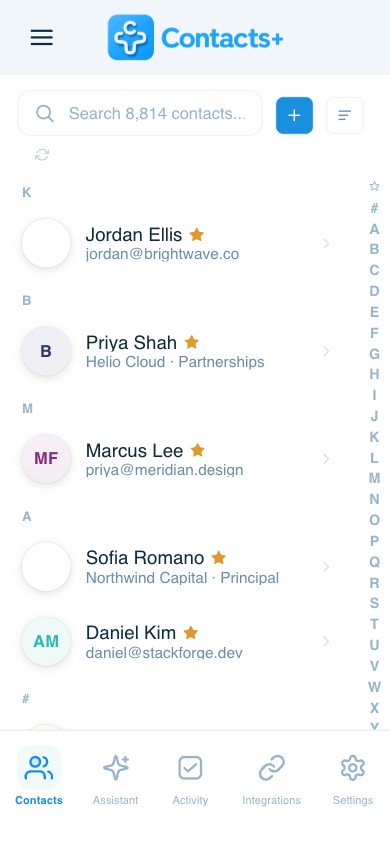
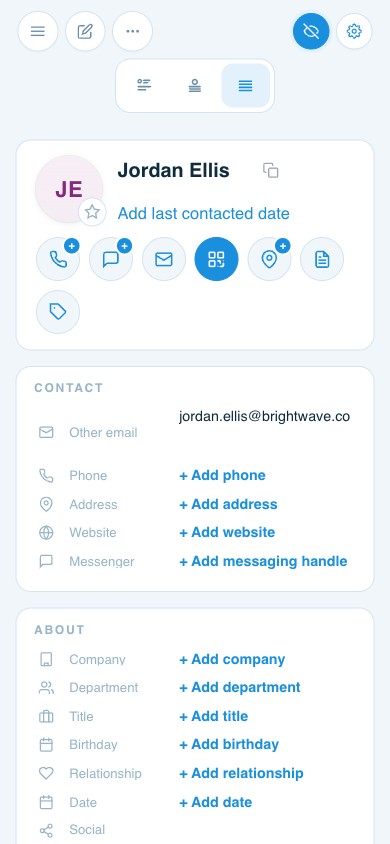
A personal CRM (like Contacts+) was built around managing relationships at the individual level, helping one person remember details about the people in their network, get reminded to follow up, and stay on top of relationships that mattered to them personally or professionally, often without any sales or marketing function attached.
That distinction, the business-scale pipeline management versus the individual relationship memory, still exists conceptually. What’s changed is how AI has affected both sides.
How AI has changed marketing CRMs
AI-native CRMs represent a meaningful shift from how CRMs worked even a few years ago. Rather than AI being bolted on as an add-on feature, it’s now woven into the core architecture. These platforms actively capture, structure, and analyze first-party data, including emails, recorded calls, and pipeline movements in real time, rather than relying on manual data entry.
This matters because manual data entry has historically been one of the biggest drains on sales and marketing teams. Some estimates suggest reps lose a substantial portion of their time to it. AI-native CRMs aim to eliminate much of that: activities, contacts, and deal stages update themselves based on actual communications and signals, rather than requiring someone to log everything by hand.
The practical effect is that marketing CRMs in 2026 increasingly feel less like a database you update and more like a system that observes your team’s activity and organizes itself, surfacing what matters (like which leads are likely to convert) rather than just storing what you tell it.
How AI has changed personal CRMs
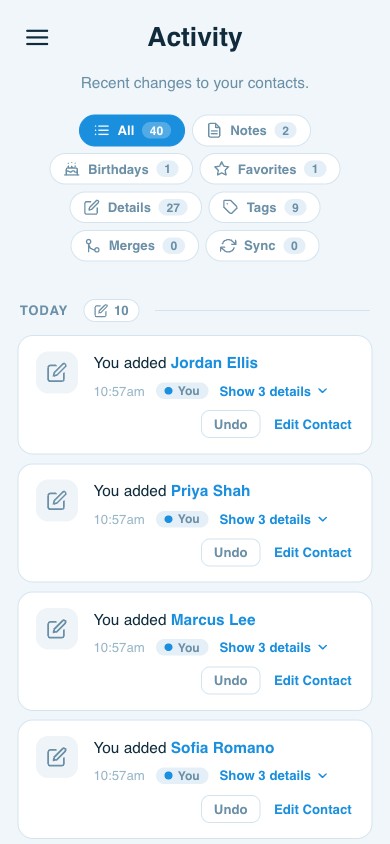
Personal CRMs have undergone an even more noticeable transformation. An AI-powered personal CRM today doesn’t just store contact details; through integration, most can combine contact storage with models that read messages, summarize calls, and draft outreach in your voice. The “remembering” function that used to require you to manually log notes about a conversation can now work automatically, with these tools surfacing context before you reach out to someone.
This has made personal CRMs useful to a wider range of people than before. What used to be a niche tool for people with very large networks (think: professional networkers, recruiters, founders) has become more broadly useful for anyone who wants help maintaining relationships without the manual upkeep.
Where the lines have blurred
Here’s where it gets more complicated. Several trends have pushed these categories closer together:
- Team features in personal CRM tools. Some personal CRM tools have added lightweight team or shared-contact features, blurring the line between “my personal network” and “our shared contacts,” a distinction that used to map cleanly onto personal versus marketing CRM.
- AI agents are handling outreach in both categories. As AI SDR (sales development representative) agents become more common in marketing CRMs, and AI drafting tools become more common in personal CRMs, the behavior of these tools, like drafting messages, suggesting follow-ups, and summarizing interactions, looks increasingly similar regardless of which category the tool was originally built for.
- Usage-based pricing models. Both categories have moved toward pricing that scales with usage or value delivered rather than simple per-seat pricing, making it harder to use pricing structure alone as a way to tell the categories apart.
- The “relationship intelligence” framing. Many tools, on both the marketing and personal side, now describe themselves using similar language around “relationship intelligence” or “relationship management,” regardless of whether they’re built for a sales team or an individual.
How to choose in 2026
Given the blurred lines, the most useful question isn’t “is this a marketing CRM or a personal CRM,” it’s a few more specific questions:
- Who needs access to this data? If the answer is “just me,” a personal CRM is likely still the better fit, even an AI-powered one with sophisticated features. If the answer is “my team, and it needs to tie to deals or campaigns,” a marketing CRM (AI-native or otherwise) is the better starting point.
- Does this need to connect to marketing or sales workflows? If you need contact data to feed into email campaigns, lead scoring, or a sales pipeline, a marketing CRM’s broader ecosystem integration usually matters more than a personal CRM’s relationship-memory features.
- How much manual upkeep are you willing to do? AI-native tools on both sides have reduced manual entry significantly, but it’s worth checking during a trial how much the tool actually automates versus how much it still asks you to maintain.
- Is human nuance important to how you communicate? One trend worth keeping in mind: tools that ignore tone, temperament, and individual communication style are likely to feel increasingly outdated. If a tool’s AI-drafted messages don’t sound like you (or like your brand), that’s worth weighing against its other features.
The bigger picture
The marketing CRM versus personal CRM distinction hasn’t disappeared. A sales team coordinating a pipeline across dozens of reps still needs fundamentally different infrastructure than an individual managing their own network. But AI has made both categories more capable, more automated, and, in terms of how they look and feel day-to-day, more similar than they used to be.
For most small businesses and individuals, the practical decision now comes down less to “which category” and more to “who’s using this, and what does it need to connect to,” which, if anything, makes the decision a bit more straightforward than it was a few years ago, even if the products themselves have gotten more sophisticated.
Frequently Asked Questions
Can a personal CRM replace a marketing CRM for a small business?
For a solo entrepreneur or very small team without a formal sales pipeline, a personal CRM with AI features may cover most needs. Once you need shared pipeline visibility, campaign integration, or lead scoring across a team, a marketing CRM becomes more appropriate.
Are AI-native CRMs worth switching to from a legacy CRM?
It depends on how much manual data entry your team currently does and how much that’s costing in time. If your team spends significant time logging activities manually, an AI-native CRM’s automatic data capture could be a meaningful efficiency gain, but switching CRMs has its own costs, so it’s worth weighing against your current pain points.
Do personal CRMs work for business relationships, not just personal ones?
Yes. Many personal CRM users use them specifically for professional relationships (clients, partners, industry contacts) rather than purely personal ones. The “personal” in personal CRM refers more to single-user usage than to non-business relationships.
Is it possible to use both a marketing CRM and a personal CRM at the same time?
Yes, and it’s fairly common. For example, a business owner might use a marketing CRM for the company’s sales pipeline while also using a personal CRM to manage their broader professional network, including contacts that haven’t yet entered the sales pipeline.
How do I know if an AI feature in a CRM is actually useful versus just a marketing buzzword?
During a trial, look for AI features that reduce a specific task you currently do manually, like drafting follow-up emails, logging call notes, or scoring leads, and evaluate the actual output quality, not just whether the feature exists.
Related articles


5 Best Marketing CRM Software For Small Businesses

What You Need to Know About Microsoft CRM
Put your contacts to work
Sync, enrich, and clean your entire address book with ContactsPlus — free to start.
Sign up free ← Back to all articles