
Client follow-up tracker
Build a client follow-up tracker
you will actually keep using
Most client trackers start in a spreadsheet, and for a while a spreadsheet is the right answer. This page covers the seven columns worth keeping, the points where a sheet starts letting you down, and what to do when you reach them.
At a glance
A spreadsheet works well as a client tracker until your contacts live in more than one place. After that it becomes one more copy to keep in step.
- Seven columns is the practical limit; longer trackers get abandoned
- A sheet can’t remind you. It waits for you to open it
- Duplicates come from the accounts that feed the sheet
- Notes and files are easier to find on the person than in a cell
Start here
The seven columns that actually work
Trackers fail from too many columns far more often than too few. Filling them in becomes the work, and then nobody fills them in.
1 · Name
One person per row. Resist the urge to put a household or a company in a single row. The moment you need to contact one of them, the row stops working.
2 · Company or context
Where you know them from. For a freelancer this is the client; for a consultant it is often the engagement. It’s what you’ll search on in six months.
3 · One contact method you actually use
Not five. If you always email this person, store the email. Columns for phone, mobile, LinkedIn and office line stay empty and make the sheet feel broken.
4 · Last contact date
The single most useful column in the sheet. Sort it oldest first and you have your to-do list. The people at the top are the ones going cold.
5 · Next action
Write it as something you’ll do. “Send the revised scope” is still actionable in three weeks’ time; “following up” is not.
6 · Next action date
Have the cell turn red when the date passes. The formula is just below the table.
7 · One line about the last conversation
Keep it to a line. “Wants to revisit after their funding round closes in Q1.” This is the column you’ll thank yourself for.
Stop there
Deal value, probability, stage, source, industry, employee count. You can argue for every one of them, and together they’re why trackers get abandoned in week three.
Copy this
Select the table below and paste it straight into Google Sheets or Excel. The header row and one worked example, so the format is obvious.
| Name | Company / context | Contact | Last contact | Next action | Next action date | Last conversation |
|---|---|---|---|---|---|---|
| Dana Whitfield | Northgate — brand refresh | dana@northgate.example | 2026-08-04 | Send the revised scope | 2026-09-02 | Wants to revisit after their funding round closes |
Two formulas worth adding. Sort ascending on Last contact and the top of the sheet is your to-do list. Then apply conditional formatting to Next action date with the custom formula =AND($F2<>"",$F2<TODAY()) turns the row red once the date passes. That is as close to a reminder as a spreadsheet gets, and it still only works when you open the sheet.
Where it breaks
The four places a client tracker spreadsheet stops being enough
None of this makes spreadsheets bad. These are just the points where the sheet starts falling behind what you actually know.
The same client exists in three places
The sheet, your phone, and your email account. Change a number in one and the other two are now wrong, and you won’t know which is current. This is where most trackers quietly stop being trusted. How contact sync works.
A sheet can’t reach you
Conditional formatting turns a cell red, but only for someone already looking at the sheet. Following up then depends on remembering to open it, which reliably favours the clients you needed least. Follow-up reminders that fire.
Duplicates arrive from outside the sheet
Two accounts syncing the same person independently will keep recreating them. Each platform de-duplicates inside its own account and cannot see the copy in another, so the duplicate comes back. The sheet inherits the mess. Merge duplicates across accounts.
The paperwork lives somewhere else
The signed scope, the deck, the photo of the whiteboard. A cell can hold a link, but the file itself sits in a folder named after a project. Six months later you’ll look for it under the client’s name, and it won’t be there. Attach files to the contact.
When you outgrow it
Moving a tracker into ContactsPlus
You don’t have to give up the spreadsheet. It just shouldn’t be the only place your client details live.
Connect the accounts first, not the sheet
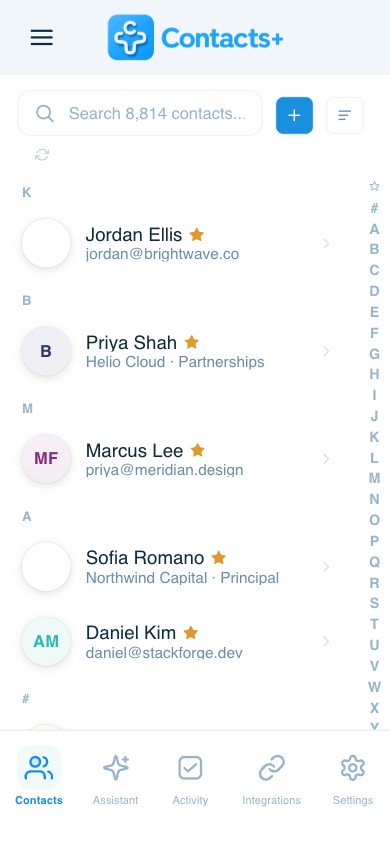
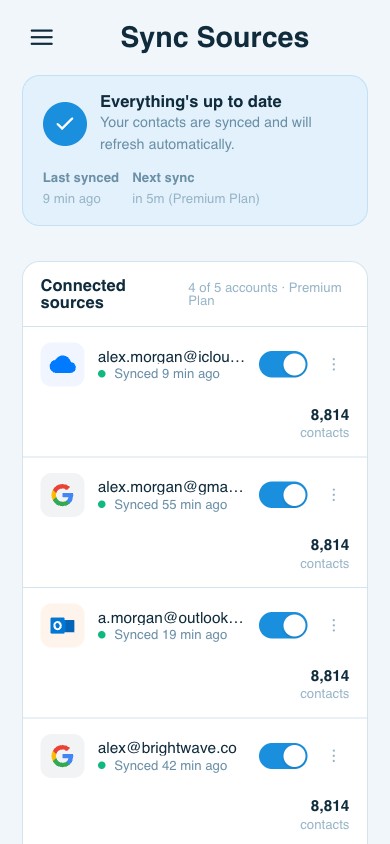
Google, iCloud and Outlook. Your clients are already in at least one of them, so the list arrives already filled in and keeps itself current from then on.
Merge what the accounts duplicated
Review the matches field by field and keep both values where both are right. Duplicate detection and merging are part of Premium.
Move the last two columns onto the person
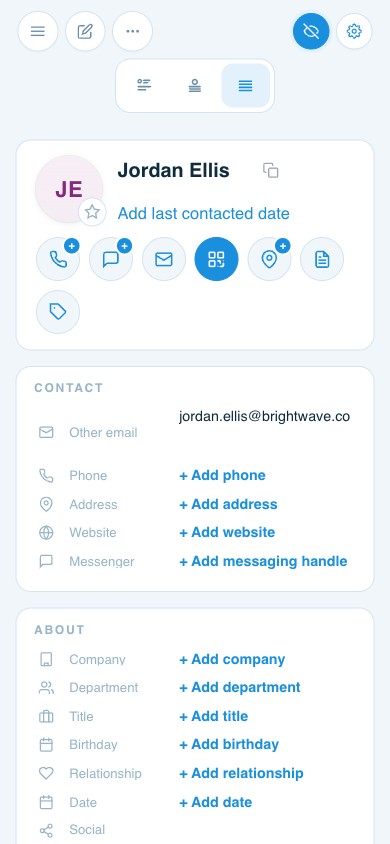
Your “next action” becomes a task attached to the client, and your one-line note becomes a note on their record. Tasks are free to try, then part of Premium and Teams.
Keep the sheet for the maths
Fee schedules, project plans, anything you actually want to calculate. Documents on a contact are free with 5 MB of storage, so the paperwork can move even if the maths stays.
Client follow-up trackers, explained
Is a spreadsheet good enough for tracking client follow-ups?
For a short list you keep yourself, yes. It’s quick, it’s free and you can shape it however you like. It stops being good enough at three specific moments: when the same client also lives in your phone and your email, when a reminder needs to reach you rather than wait to be looked at, and when a second person needs the same view.
What columns should a client follow-up tracker have?
Name, company or context, one contact method you actually use, last contact date, next action, next action date, and one line about the last conversation. Seven is usually the limit. Trackers with twenty columns get abandoned because filling them in becomes the work.
How do I get my contacts out of my phone and into a spreadsheet?
Google Contacts exports to CSV from contacts.google.com, and Outlook exports to CSV from its People area. iPhone has no direct CSV export. Those contacts live in your iCloud account, so the practical route is to export from the Google or Outlook account they sync with. See exporting contacts.
Why do duplicates keep appearing in my client list?
Because two accounts are syncing the same person independently. Each platform de-duplicates inside its own account and none of them can see the copy sitting in another, so the duplicate regenerates every time the accounts disagree. A spreadsheet can’t fix that, because it’s a symptom of the accounts feeding it rather than of the sheet.
Can I keep the spreadsheet and use an app as well?
Yes, and it’s a sensible way to start. Keep the spreadsheet for anything bespoke, such as a fee schedule or a project plan, and let the contact record hold the things that need to stay current: the person’s details, the notes, the files and the next follow-up.
Let the list keep itself current.
Connect the accounts your clients already live in, and the tracker stops being a second copy you have to maintain. Free to start.
Start free