
Comparisons
Compare ContactsPlus
Every ContactsPlus comparison in one place. Each one sets out what ContactsPlus does that the other tool doesn’t, and what they both do, using details from that company’s own published pages. If an alternative is the better fit for you, these pages will tell you so.
At a glance
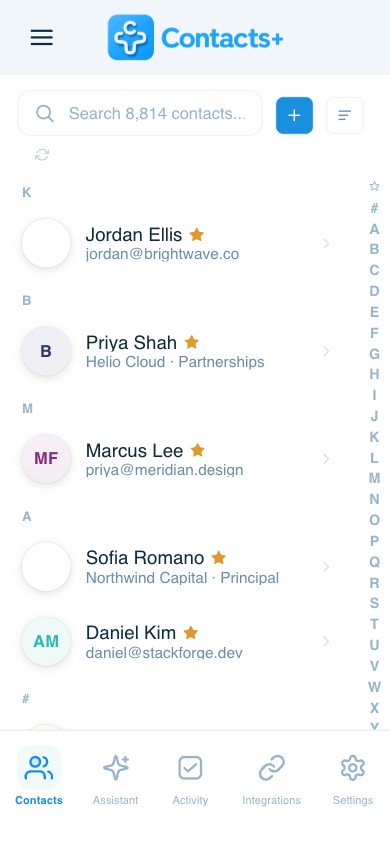
Compare ContactsPlus: most contact managers are built on one provider, usually Google. ContactsPlus keeps Apple iCloud, Google and Microsoft up to date together, in both directions, and merges the same person into a single record.
- One address book across all three, with the duplicates between them merged
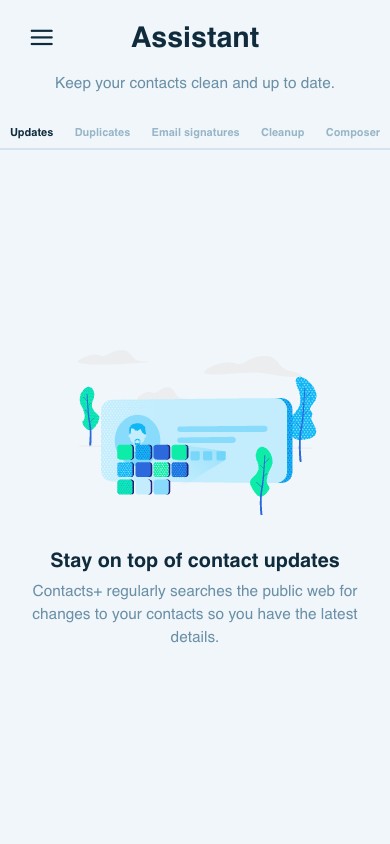
- Reads the signature on mail you already receive and fills in the missing details by itself
- Follow-up tasks on the contact that push to your calendar, and become the team’s once you share them
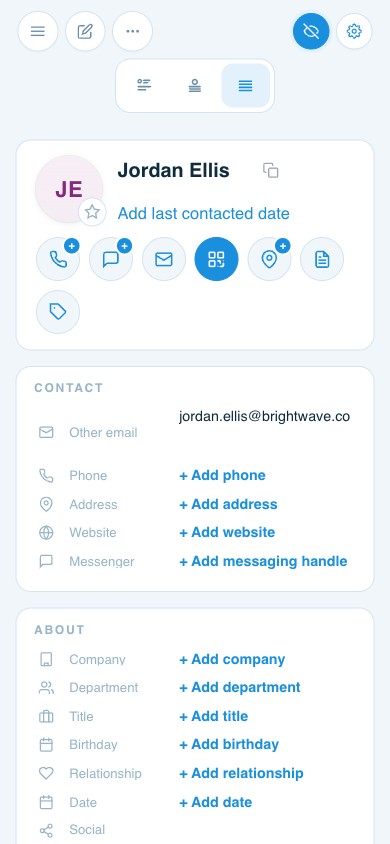
- Attach a document to one contact or to several at once. Stored once, on any plan
- Scan a card, a badge, or a screenshot of any page straight into a contact
- Free forever, so you can check all of it yourself
Head to head
ContactsPlus vs the alternatives
Pick the one you’re actually weighing up. Each page runs the full feature-by-feature table, not a summary.
ContactsPlus vs Google Contacts
Everyone you know, in one list. ContactsPlus pulls your Google, Outlook and iPhone contacts together, removes the duplicates and fills in what is missing.
Google Contacts only ever sees Google.
ContactsPlus vs ContactBook
One person, one record. If the same person sits in Google, Outlook and on your iPhone, ContactsPlus keeps all three up to date and shows you a single clean contact.
ContactBook updates Google only, and only every few hours. Your iPhone contacts never arrive at all.
ContactsPlus vs Dex
Fix a number once. Change a phone number on your laptop, on your phone or in Gmail, and ContactsPlus corrects it everywhere else.
Dex can send contacts out to Google, but nothing comes back. Fix a number in Gmail and Dex never hears about it.
ContactsPlus vs Covve
Photograph it, and it becomes a contact. A business card, a badge, or a screenshot of a LinkedIn profile or team page. ContactsPlus reads the details, files them, and keeps them current from then on.
Covve hands the contact over once. After that it stops updating.
ContactsPlus vs Shared Contacts for Gmail
Google, Outlook and your iPhone, treated the same. ContactsPlus reads from all three and writes back to all three, so no single account has to be the master copy.
ContactsFlow lives inside Gmail. Outlook and phones only receive a copy of your Google labels, and iPhone contacts aren’t covered.
UpHabit alternative
Your export stops going stale. Import the file UpHabit gave you and ContactsPlus keeps that list current from then on, instead of letting it age in a folder.
UpHabit closed in April 2026.
The short version
Which one should you actually pick?
The honest one-line answer for each, before you read anything longer.
| Alternative | Pick it when… | Pick ContactsPlus when… |
|---|---|---|
| Google ContactsFree, included with Google | Everything you own lives in one Google account and you don’t mind cleaning it by hand. | Your contacts are also on an iPhone or in Outlook, or the same person exists three times. |
| ContactBookShared lists inside one Google org | You want the cheapest possible shared contact list inside a single Google organisation. | Contacts span Google, Microsoft and Apple, and four-hour-old data isn’t good enough. |
| DexPersonal CRM, follow-up first | Your priority is remembering to follow up, and you want LinkedIn and your inbox logging it for you. | You need the underlying record correct in Google, iCloud and Outlook — not only inside one app. |
| CovveBusiness-card capture at events | You capture a hundred cards a day at events and push the leads into a sales CRM. | You need those contacts to stay right afterwards, deduplicated across every account you own. |
| Shared Contacts for GmailShared labels inside Gmail | Everyone is on Google Workspace, staying there, and you want shared labels inside Gmail without leaving Gmail. | Anyone on the team works from an iPhone or a Microsoft account as their source of truth. |
| UpHabitClosed April 2026 | Not an option — the product has shut down. | You have an export sitting in a folder and want it to stay current on its own. |
Every figure about another product is taken from that company’s own published pages and dated, each comparison says where the alternative beats us, and where a ContactsPlus feature needs a paid plan we name it. Check any of it against our pricing page.
The through-line
The one thing most alternatives don’t do
Read enough of these and the same gap shows up every time. Almost every contact tool is built on a single provider, usually Google, because one provider is far easier to build on. Real address books aren’t shaped like that.
Your contacts are already scattered
Work email in Microsoft, personal phone contacts in iCloud, everything else in Gmail. A tool that only reads one of those isn’t managing your address book. It’s managing a third of it, while the rest quietly drifts.
Two-way, in real time
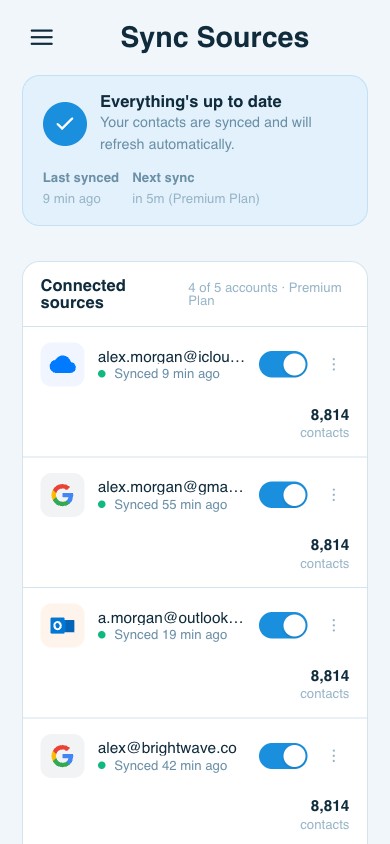
ContactsPlus syncs Apple iCloud, Google and Microsoft together, in both directions, as changes happen. You set the direction for each account, and nothing is moved out of the source. It stays exactly where it was.
The duplicates live between accounts
Pull several sources together and the same person appears repeatedly. Single-provider tools can’t see those, because the copies aren’t in the account they’re looking at. ContactsPlus matches and merges across every connected account.
Then it fills the gaps
A unified list is only useful if the records are complete. Enrichment fills in titles, companies and photos, outdated-data cleanup flags records that have gone stale, and card scanning gets new people in without typing.
If your contacts genuinely only live in one place, a single-provider tool is cheaper and you should buy it. The comparisons above will help you work out which case you’re in.
Questions
Frequently asked questions
What makes ContactsPlus different from other contact managers?
Most contact tools are built on one provider, usually Google. ContactsPlus syncs Apple iCloud, Google and Microsoft together into a single address book, two-way and in real time, then merges the duplicates between those accounts and fills in the missing details. The multi-source part is what the alternatives generally don’t do.
Is there a free version of ContactsPlus?
Yes. ContactsPlus Free is free forever: one synced account, 1,000 contacts, and the full contact record including notes, tasks, custom fields and file attachments. Several alternatives offer only a time-limited trial.
Do I have to move my contacts to use ContactsPlus?
No. ContactsPlus syncs with the accounts your contacts already live in rather than replacing them. Gmail autocomplete, your iPhone contacts and Outlook all keep working exactly as before, and if you disconnect later every source account is untouched.
What do these comparisons actually cover?
Each comparison sets out what ContactsPlus does that the alternative doesn’t, and what both of them do, so you can see where they genuinely overlap. Every detail about the other product comes from that company’s own published feature and help pages.
How current are the figures in these comparisons?
Every detail about another product is taken from that company’s own published feature and help pages at the time the comparison was written. Products change, so check the other company’s own site before you decide.
Already decided
Switching guides
If you have made your mind up and just want to know how to move your contacts across, start here instead.
Google Contacts alternative
How to keep Google exactly as it’s and add Apple iCloud, Microsoft and cross-account duplicate merging on top. Nothing is exported by hand.
ContactBook alternative
Export first, reconnect the same Google and Microsoft accounts, add the iCloud account behind your phone, then merge what turns up.
Shared Contacts for Gmail alternative
For teams who aren’t all on Google: bring Outlook and iPhone contacts in as real sources and set up one shared address book with roles.
UpHabit alternative
UpHabit has closed. How to get your data out and give the relationships you were tracking a permanent home.
More on choosing a contact manager
See it on your own contacts.
Connect an account, watch it sync, see your own duplicates surface. Free forever, no card required.
Try ContactsPlus free