
Comparison
ContactsPlus vs
Covve
Covve is built to get a contact in. ContactsPlus is built to keep that contact right everywhere, for good. Covve’s own site describes sending contacts to Google, Outlook or your phone “in one tap”. That is an export, and an export stops updating the moment it lands.
ContactsPlus
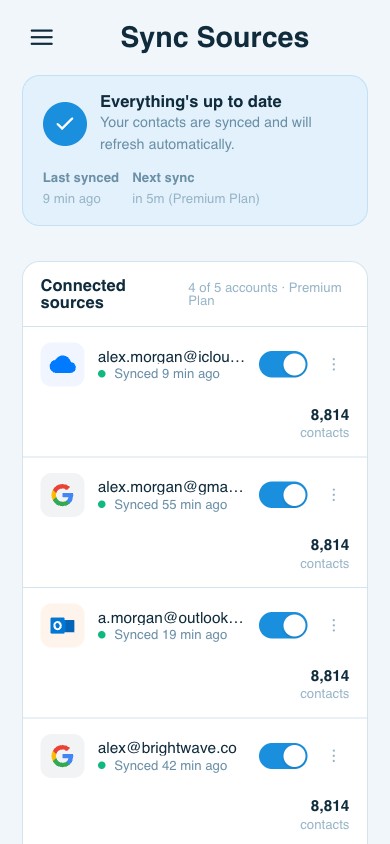
Three accounts, both directions, as changes happen.
Result: one address book that stays correct in every account. Change a job title once and every connected account is corrected.
Covve
Capture, then send outward — one tap, one time.
Result: the contact lands accurately, then stops. Nothing reads those accounts back, so a later correction never finds the copies.
Every Covve detail on this page comes from their own product, integrations, teams and pricing pages, captured in August 2026.
At a glance
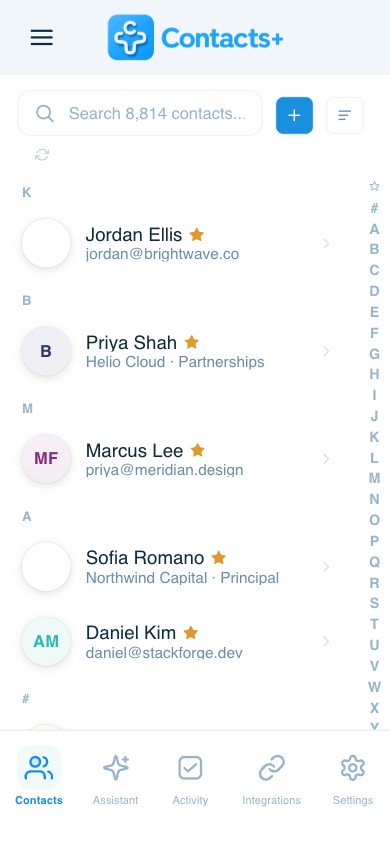
ContactsPlus vs Covve: across 48 compared features, 29 are available only in ContactsPlus and 19 exist in both. Covve is a lead-capture and business-card product; ContactsPlus is a contact-sync product. The gap is direction, not quality.
- Two-way sync with Apple iCloud, Google and Microsoft — Covve sends contacts outward only
- Apple iCloud isn’t on Covve’s integrations list at any price
- Duplicate detection across your whole address book, not only across new scans
- A free forever plan, where Covve offers a 14-day trial
- What Covve does better: unlimited offline card scanning in 60+ languages, voice capture, an included digital business card and native CRM connectors
The scoreboard
48 features compared
Every capability in the matrix below, checked one by one against Covve’s published pages .
29
Only in ContactsPlus
19
In both products
The core difference
Captured once, and still right months later
ContactsPlus keeps Apple iCloud, Google and Microsoft in two-way sync, so a detail you fix anywhere is fixed everywhere. Covve sends contacts outward, to a phone, a spreadsheet, Google or Outlook — and an export stops updating the moment it lands.
You meet someone at a conference. Covve scans their card in seconds and gets every field right: name, title, company, mobile, email. One tap sends it to Google Contacts. This part Covve does better than we do.
They change jobs. New company, new title, new work email. Their old title is now wrong in the copy sitting in Google Contacts, wrong in the copy on your phone, and wrong in the spreadsheet you exported.
Covve can’t fix it, because it never reads the account it wrote to. The send was a one-off. There is no return path from Google Contacts or Outlook back into Covve, so nothing tells it the record has moved on.
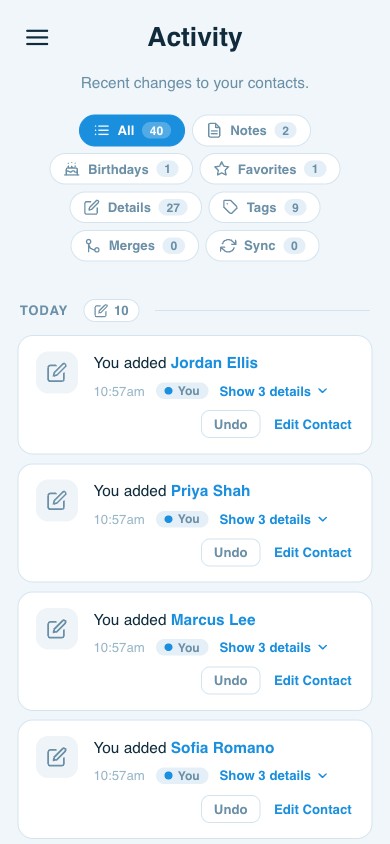
You correct the title once. Because Apple iCloud, Google and Microsoft are connected accounts rather than export targets, the correction travels to all of them, and the outdated-data cleanup on Premium flags stale records before you have even noticed. How sync works →
You choose
Three ways to sync, and you pick for each account
Not every account should behave the same way. A work Google account might need to stay identical in both places, while an old iCloud account should only ever be read. ContactsPlus lets you set the direction on each account separately, change it whenever you like, and it applies in real time.
Two-way sync
Your account and ContactsPlus stay perfect copies of each other. Every add, edit and delete flows in both directions.
Pull contacts in
One-way, into ContactsPlus. It only reads, so your source account is never changed. It’s the lightest and fastest option.
Push contacts out
One-way, outward. ContactsPlus pushes your cleaned-up master list to an account, and is never changed by it. This is the direction Covve offers, the difference is that for us it’s one of three.
Worth saying
If all you need is a card reader
A dedicated scanning app will clear a stack of expo cards, and if that’s the whole job it will do it. ContactsPlus is built for what happens next: the details you captured staying correct across Apple iCloud, Google and Microsoft, months later, without you touching them again.
Beyond a clean address book
Four things ContactsPlus does that most tools leave to you
Getting the contacts right is the start. These are the four that save the most time afterwards.
Email signatures, read for you
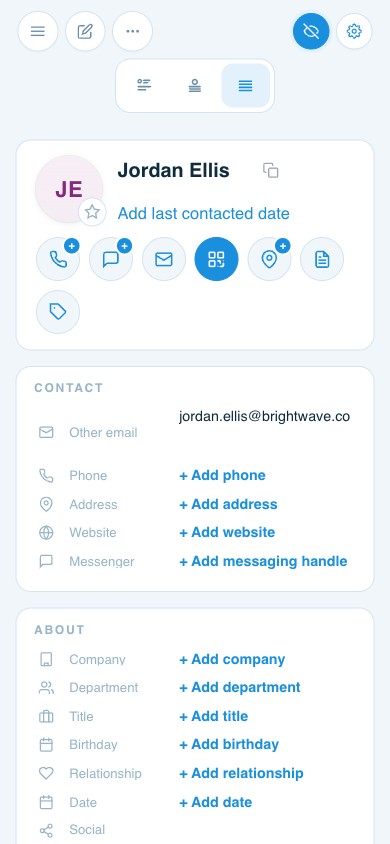
ContactsPlus reads the signature block on mail you already receive and fills in the job title, company and direct line by itself. Nothing to copy, nothing to type. The records just get better while you work. Premium and Teams.
Tasks that reach your calendar
Give a follow-up a due date and time and it turns up in your calendar, whether that’s Google, Outlook or Apple. Snooze it, filter a long list down to today, and start each morning with a digest of what is due.
Team tasks, with real permissions
Put a task in a shared address book and it becomes the team’s. Assign it to a colleague, control who can act on it, and see who closed it and when. Everyone works the same list instead of chasing each other. Teams.
One document, many contacts
Attach a contract, proposal or scan to the person it belongs to, and to everyone else involved. Link one file to as many contacts as you like: it’s stored once and counted once against your storage, however many people it sits on. On every plan, team or not.
The full matrix
Every feature, side by side
Where a ContactsPlus feature needs a paid plan, we name the plan rather than quietly implying it’s free.
| Feature | ContactsPlus | Covve |
|---|---|---|
| Sync & accounts | ||
| Apple iCloud syncOnly usNative two-way sync, no bridge | ✓ | — |
| Two-way Google Contacts syncOnly usTwo-way, read as well as written | ✓ | — |
| Two-way Microsoft / Outlook syncOnly usTwo-way, read as well as written | ✓ | — |
| Send contacts out to Google Contacts & OutlookBoth products can write into those address books | ✓ | ✓ |
| Edits made in your account flow back inOnly usCorrect a number in Gmail and it reaches every other account | ✓ | — |
| Choose the sync direction per accountOnly usTwo-way, pull in, or push out, set per account and changeable any time | ✓ | — |
| Apple, Google and Microsoft kept in one continuous syncOnly us5 accounts on Premium, 10 on Teams | ✓ | — |
| Real-time updatesQuick sync on Premium & Teams | ✓ | ✓ |
| Export to Excel, CSV or vCard | ✓ | ✓ |
| Capturing contacts | ||
| Business card scanning100 cards a month on Premium, and it reads screenshots too | ✓ | ✓ |
| Transcribe any image showing contact detailsOnly usNot just cards. An email-signature screenshot, a LinkedIn profile, a conference badge, even a handwritten note | ✓ | — |
| CSV & vCard import | ✓ | ✓ |
| Cleaning up contact data | ||
| Deduplication of newly captured contactsScans the whole address book, on Premium and Teams | ✓ | ✓ |
| Duplicate detection across your whole address bookOnly usPremium & Teams. Not only new captures. The twenty thousand contacts you already had, too. | ✓ | — |
| Merge the same person held in different providersOnly usOne record for the person, whether they sit in Gmail, iCloud or Outlook | ✓ | — |
| Contact enrichmentPremium & Teams, across your whole address book | ✓ | ✓ |
| Enrichment applied to contacts you already haveOnly usRuns on your existing contacts, not only on new captures | ✓ | — |
| Profile photo matchingOnly usPremium & Teams | ✓ | — |
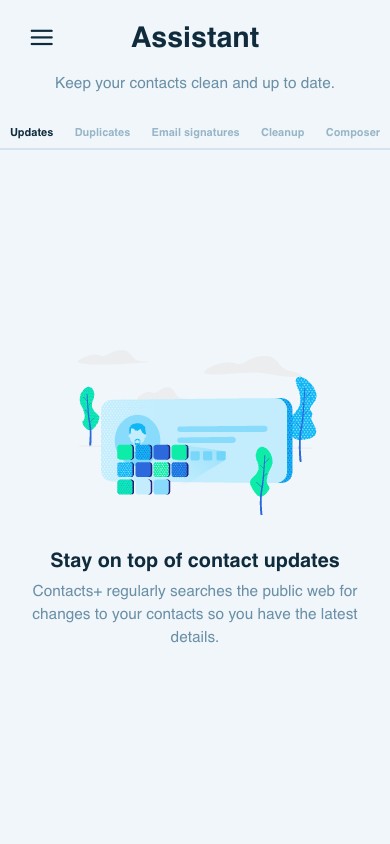
| Outdated data cleanupOnly usFlags contacts whose details have gone out of date, on Premium and Teams | ✓ | — |
| Email signature extraction (Gmail)Only usPremium & Teams | ✓ | — |
| The contact record | ||
| Emails, phone numbers & addressesAdd as many as you need per contact | ✓ | ✓ |
| Job title, company & department | ✓ | ✓ |
| Website URLs & social profiles | ✓ | ✓ |
| Profile photos | ✓ | ✓ |
| Custom fields | ✓ | ✓ |
| Messaging handles (IM)Only us | ✓ | — |
| Relationships between contactsOnly usLink family, colleagues & referrals | ✓ | — |
| Notes on a contact | ✓ | ✓ |
| Dated note historyOnly usA running history on the record, not one free-text box | ✓ | — |
| Tags, groups & filters | ✓ | ✓ |
| Follow-ups & tasks | ||
| Tasks & follow-up reminders on a contactOnly usOn every plan, including free | ✓ | — |
| Due dates, snooze and rescheduleOnly us | ✓ | — |
| Push follow-ups to your calendarOnly usOne-way push to Google, Outlook & Apple | ✓ | — |
| Daily task digest emailOnly us | ✓ | — |
| Branded task activity reportsOnly usPremium & Teams | ✓ | — |
| Shared team tasks with assignmentOnly usTeams | ✓ | — |
| Documents on the contact record | ||
| Attach files to a contactOnly us5 MB per file on free, 10 GB of storage on Premium | ✓ | — |
| A library of every file, across all contactsOnly usAnswers “where is that quote?” when you can’t remember whose record it’s on | ✓ | — |
| Link one file to many contactsOnly usStored once, counted once against your storage | ✓ | — |
| Virus scanning on uploadOnly usFlagged files quarantined, not silently deleted | ✓ | — |
| 30-day Trash for deleted filesOnly usRestore a file, or empty Trash to reclaim space | ✓ | — |
| Sharing with a team | ||
| A shared contact list for the teamShared address book on Teams | ✓ | ✓ |
| User roles & licence management | ✓ | ✓ |
| Shared notes & a named contact ownerOnly usTeams, up to 50 members | ✓ | — |
| Apps & plans | ||
| Web app | ✓ | ✓ |
| iOS app | ✓ | ✓ |
| Android app | ✓ | ✓ |
| Free forever planOnly us1,000 contacts, one synced account and the full contact record | ✓ | — |
A dash means the capability is either not offered or not documented anywhere on that product’s own site. All Covve entries were taken from their published product, integrations, teams and pricing pages in August 2026; all ContactsPlus entries from our pricing page. Their plans are theirs to change — check their pricing before you decide. Comparing something else? ContactsPlus vs ContactBook.
The decision
Which one should you buy?
These two products solve different problems. The quickest way to choose is to say out loud which problem is actually yours.
Choose Covve if…
- Your problem is volume capture at events: a hundred cards a day, often with no signal.
- You need those leads landing in Salesforce, HubSpot, Zoho, Pipedrive or Dynamics 365 without a CSV in the middle.
- You want a digital business card with NFC and wallet sharing bundled in.
- You want AI to qualify a lead the moment it’s scanned.
Choose ContactsPlus if…
- Your problem is that the same people are stored differently in three accounts and keep going out of date.
- You want Apple iCloud, Google and Microsoft to agree with each other, permanently, without you doing anything.
- You want duplicates reconciled across the whole address book, not only across new scans.
- You want follow-ups, notes and documents living on the contact record itself.
Moving over
How to move to ContactsPlus from Covve
Four steps, and the first one is the safety net. Nothing here needs a support ticket.
1. Export from Covve first
Before you cancel anything, get your data out. Their own site says you can export selected or all contacts to Excel, or send them to Google Contacts and Outlook Contacts. Keep the file. It costs nothing and it makes the decision reversible.
2. Connect the same accounts
Sign in to ContactsPlus and connect the Google and Microsoft accounts Covve was sending to, then add the iCloud account your iPhone uses, which Covve has no integration for. Contacts arrive as live accounts, not a static file. More on how sync works.
3. Run duplicate detection
Pulling several sources together surfaces duplicates, and years of one-tap exports will have left a few. Run duplicate detection and merge what it finds, including the same person held in different providers, which is the case scan-level dedupe can never catch.
4. Let enrichment fill the gaps
Cards give you a name, a title and a number. Enrichment fills in what the card never had, profile photo matching puts a face to the record, and outdated data cleanup flags the ones that have gone stale since you scanned them.
Nothing is moved out of Google, Microsoft or Apple. ContactsPlus syncs with them. Gmail autocomplete keeps working, your iPhone keeps showing your contacts, and if you disconnect later, every source account is exactly where you left it.
Questions
Frequently asked questions
What is the main difference between ContactsPlus and Covve?
Direction. Covve is built to get a contact in: scan a card, speak a name, then send the result to your existing tools. Their own site describes sending contacts to your phone address book, Excel, Google, Outlook or Zapier “in one tap”. That is an export, and it stops updating the moment it lands. ContactsPlus treats Apple iCloud, Google and Microsoft as accounts it keeps in continuous two-way sync, so a correction made anywhere reaches everywhere.
Can ContactsPlus sync my iPhone contacts?
Apple iCloud doesn’t appear on Covve’s integrations page at all. Their list is Salesforce, HubSpot, Zoho, Pipedrive, Dynamics 365, Zapier, Outlook Contacts, Google Contacts and Excel. Covve can save a scanned contact to the phone you scanned it on, but there’s no iCloud account connection at any price. ContactsPlus syncs Apple iCloud two-way, alongside Google and Microsoft, on every paid plan.
Does ContactsPlus sync Google Contacts in both directions?
No. Their integrations page describes it as “Send new leads directly to Google Contacts”, and the Outlook entry as “Sync leads and contacts to Outlook”. Both are outbound. Covve writes into those address books but doesn’t read them back, so an edit you make in Gmail or Outlook never returns to Covve. ContactsPlus reads and writes both, and lets you set the direction per account.
Can I use ContactsPlus on a computer as well as a phone?
Yes. Covve lists a Web Portal in its product navigation, and the teams page describes leads auto-syncing to your CRM via “the web-based Covve Portal”, plus a web admin portal for licences and lead activity. Some review round-ups describe Covve as mobile-only; their own site says otherwise, and we would rather quote the source. ContactsPlus also has a web app, plus iOS and Android.
Can ContactsPlus merge duplicates across my accounts?
Within its own flow, yes. Covve says scanned contacts are “automatically structured and de-duped”, and that it “intelligently deduplicates records during every sync” so updates flow into your CRM without creating duplicates. The difference is scope. That dedupe covers what Covve captures and what Covve writes. It can’t reconcile the same person held in Gmail, iCloud and Outlook, because Covve never reads those accounts. ContactsPlus dedupes across your whole address book, including the same person stored in different providers.
Does ContactsPlus scan business cards?
Yes. 100 cards a month on Premium, and 100 per user per month on Teams. It isn’t limited to cards either: any image showing contact details works, including an email-signature screenshot, a LinkedIn profile, a conference badge or a handwritten note. If your job is scanning hundreds of cards at an event, though, Covve is the stronger scanner — it sells unlimited scans, works offline and reads 60+ languages.
Can I use ContactsPlus alongside a card-scanning app?
Yes, and some teams do. Covve captures at the event and pushes the lead into Google Contacts, Outlook or the company CRM. ContactsPlus is connected to those same Google and Microsoft accounts, so the new contact arrives in your address book automatically, gets deduplicated against what you already have, and stays current from then on. Covve handles the intake; ContactsPlus handles the upkeep.
How do I move from Covve to ContactsPlus?
Export from Covve first. Their own site says you can export selected or all contacts to Excel, or send them to Google Contacts and Outlook Contacts. Then connect those same Google and Microsoft accounts to ContactsPlus, and add iCloud, so your contacts arrive as live accounts rather than a static file. Run duplicate detection over what lands, merge what it finds, then let enrichment fill the gaps.
More on choosing a contact manager
Capture it once. Keep it right forever.
Apple iCloud, Google and Microsoft in one list, with the duplicates gone. Free to start, no card needed.
Try ContactsPlus free