
Contact sync
iCloud contacts sync,
and where it stops
iCloud is very good at one job: making sure all your Apple devices show the same address book. Nearly every problem people hit comes from expecting it to do the other job as well, which is keeping Apple, Google and Microsoft in agreement. It has never tried to do that.
At a glance
Only contacts saved to the iCloud account sync. Anything saved to On My iPhone stays on that one phone, no matter how the account is set up.
- Check iCloud.com. What you see there is what can sync
- Set the default account for new contacts, or they’ll save to the device
- iCloud matches your Apple devices to each other, and nothing else
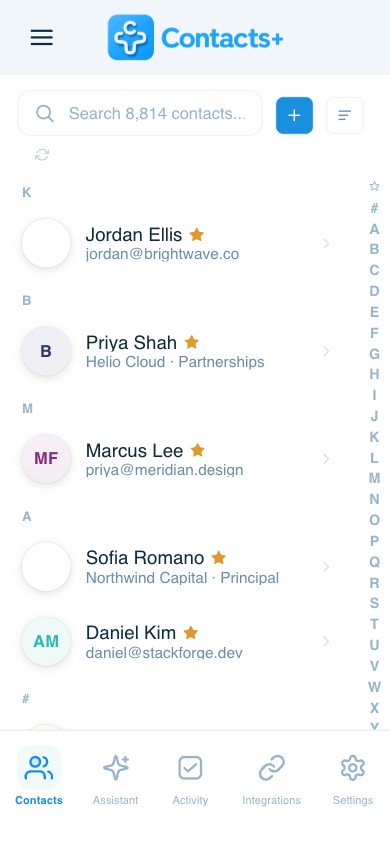
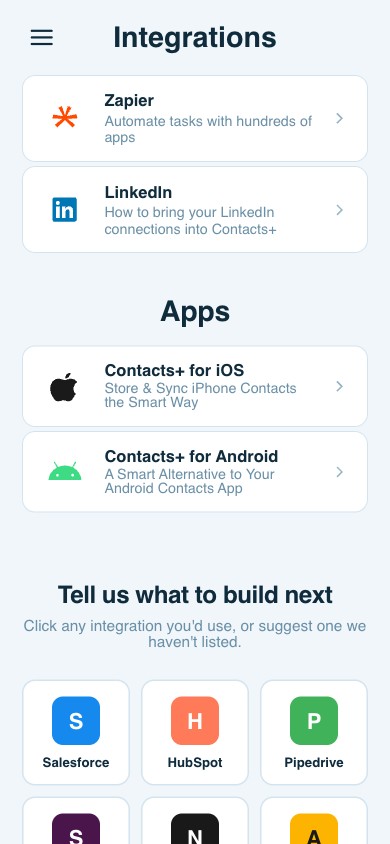
- ContactsPlus connects iCloud, Google and Microsoft and keeps them as one list
The built-in route
How to get iCloud contacts syncing
Apple keeps renaming these screens, so these steps are about which account a contact belongs to. That doesn’t change, even when the menus do.
Turn Contacts on for iCloud
On the iPhone open Settings, tap your name at the top, then iCloud, and confirm Contacts is switched on. On a Mac the same switch sits in System Settings under your Apple Account, then iCloud.
Set the account new contacts save to
In Settings open Contacts and then Default Account, and choose iCloud. Leave it on On My iPhone and every contact you make from now on is saved to that one phone and never goes anywhere.
Check what is actually in iCloud
Sign in at iCloud.com and open Contacts. Whatever shows up there is in iCloud and can sync. If you can see it on the phone but not on iCloud.com, it’s only on that one device.
Move the local contacts in
Contacts under an On My iPhone group have no copy on Apple’s servers, so there’s nothing for a second device to pick up. Move them into the iCloud account.
Decide how Google and Outlook fit in
iCloud won’t keep a Google or Microsoft address book up to date for you. A vCard export is a one-off snapshot. If you want those accounts joined up rather than copied, you need something sitting above all three.
Troubleshooting
iCloud contacts not syncing? Start here
Work down this list in order. The first two cover most cases, and neither needs a reset.
They were saved to the device
A contact in the On My iPhone account has no copy on a server, so no other device can ever get it. It’s the biggest cause and the hardest to spot, because the app shows local and iCloud contacts mixed together in one list.
The default account is wrong
Old contacts sync but new ones don’t? Your default account is set to the device, not iCloud, so everything you add is going to the wrong place.
Contacts is switched off for iCloud
Photos and notes come through, so the account looks fine. Contacts has its own switch in the iCloud settings and can be off by itself. Check it on every device, not just the phone.
Two Apple Accounts, two address books
An iPad signed in to an older Apple Account is looking at a completely different address book. Same person, same house, different account. Nothing will join them up.
Where it runs out
iCloud matches your devices. It doesn’t reconcile your accounts.
Inside Apple this works well. Across the accounts most people actually use, it doesn’t even try.
No native Google or Outlook sync
Apple won’t keep a Google or Microsoft address book up to date. However good that first import looked, the two sides never talk again.
Side by side isn’t combined
Add a Google account to an iPhone and both sets show up in the Contacts app. They’re still two separate lists in one view. The fact you can filter by account is the giveaway that they never merged.
Linked cards are a display trick
iOS can link duplicate cards from different accounts so they look like one person. But linking only changes what you see, not what’s stored. Edit one and the other still has the old details.
vCard is a snapshot, not a sync
An export lands once and starts going stale straight away. Every change after that happens in one place only, and re-importing to catch up just makes another round of duplicates.
Nothing reconciles conflicting edits
Fix a number on your iPhone and the Google copy still has the old one. Nothing decides between them, so both versions survive and you can’t tell which is newer.
Most tools reach iCloud through a bridge
Apple is the one account most contact apps and CRMs can’t reach directly, so they go through a third-party sync bridge. That’s one more thing between you and your own contacts.
The layer above
iCloud, Google and Outlook in one address book
Built-in sync keeps each account tidy on its own. ContactsPlus is what makes them add up to one list.
Apple connected directly
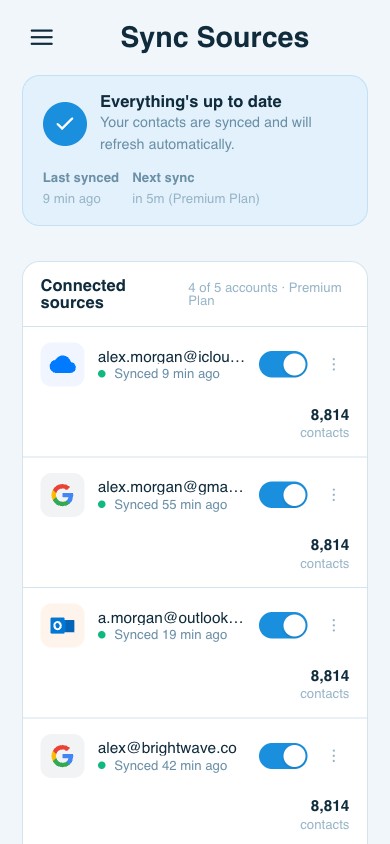
ContactsPlus talks to Apple, Google and Microsoft itself, with no sync bridge in between, and you choose the direction for each account. See how contact sync works.
Duplicates merged, not linked
Detection runs across every connected account at once, and it really does combine the records instead of just showing two as one. See duplicate iCloud contacts.
Records that improve themselves
Enrichment fills in what nobody bothered to type. Card scanning adds new people without retyping them. Email signatures top up the details as mail comes in. See contact enrichment.
Room for work and personal
Free syncs one account and 1,000 contacts. Premium connects five accounts and 25,000 contacts with real-time sync; Teams raises that to ten accounts, unlimited contacts and a shared address book. See pricing.
Syncing something else?
Other places contacts get stuck
It works differently in each ecosystem. These cover the rest.
Google Contacts sync
Turning it on, fixing contacts that stop syncing, and the Google-to-Apple gap from the other side.
Outlook contacts sync
Where Outlook and Microsoft 365 actually store contacts, and why some never leave one PC.
Sync contacts from iPhone to iPad
Two Apple devices on one list, and the default save account that decides whether it works.
FAQ
Frequently asked questions
Why are my iCloud contacts not syncing?
Usually it’s because the contacts were saved to the On My iPhone account instead of iCloud, so there’s no copy on Apple’s servers and nothing to sync. After that, the two most common causes are Contacts being switched off for iCloud, and the device being signed in to a different Apple Account from the one you’re looking at.
How do I tell whether a contact is saved locally?
Sign in at iCloud.com and open Contacts. What you see there is what lives in iCloud and can sync. If it’s on the phone but missing from iCloud.com, it’s on that device only.
Can I sync iCloud contacts with Google?
Not on its own, and not both ways. Apple and Google don’t keep each other up to date. You can add a Google account to an iPhone and see both sets in the same app, but they stay two separate lists that never join. ContactsPlus connects both accounts and keeps them unified instead.
Why does my iPhone show the same person twice?
Because that person is in more than one account on the device, usually iCloud and Google. iOS can link the cards so they look like one entry, but that only changes how they’re shown. The records underneath stay separate, so an edit to one never reaches the other. See duplicate contacts in iCloud.
Does ContactsPlus connect to iCloud directly?
Yes. ContactsPlus talks to Apple itself instead of going through a third-party sync bridge. That’s why a contact you add on your iPhone and one you add in Gmail end up in the same list, with no duplicate. Most contact apps and CRMs can’t reach iCloud without a bridge.
How does ContactsPlus handle iCloud?
It connects iCloud alongside Google and Microsoft and keeps them unified in one address book, with a sync direction chosen per account, duplicate detection across all of them, and export to CSV or vCard whenever you want your data out. Free syncs one account and 1,000 contacts once a day; Premium connects five accounts and 25,000 contacts with real-time sync; Teams raises that to ten accounts and unlimited contacts. See pricing.
More on Apple and iCloud contacts
Apple, Google and Microsoft. One list.
Connect iCloud directly. No bridge, no vCard, no copy-paste, and no more keeping three address books up to date by hand.
Start free