
How to choose
The best contact management software
is the one that fits your mess
We make one of these, so treat this as interested advice rather than a neutral review. What follows is the evaluation we would want someone to run — including the cases where the honest answer is that you don’t need to buy anything.
At a glance
Judge contact management software on how much it does without you — unifying accounts, merging duplicates, and improving records on its own. Storing a name and a number isn’t a differentiator.
- Name the actual problem before looking at products
- Test on your real contacts, never on a demo
- Check the export before you commit, not after
- If you need pipeline stages, buy a CRM instead
The criteria that matter
Six questions that actually separate them
Feature lists converge. These are the questions where products genuinely differ, and where the answers are easy to check.
1 · Does it unify several accounts?
The single biggest divider. Plenty of tools manage one account well. If your contacts are split across a work Google account, a personal iCloud account and Outlook, a tool that only reads one of them leaves the problem intact.
2 · Does it merge duplicates across them?
Deduplicating within one account is common. Finding the same person in two different accounts and merging them field by field is much rarer, and it is where most of the mess actually lives.
3 · Does it improve records on its own?
A list that only contains what you typed decays steadily. Enrichment is the difference between a list you maintain and a list that maintains itself.
4 · Can a team share one list?
If more than one person needs the contacts, check for a genuinely shared address book with roles — not an export you email round, which is how most teams end up with five versions.
5 · How fast is capture?
Anything that makes adding a contact tedious will quietly stop being used. Scanning a card or a screenshot beats typing fields on a phone.
6 · Can you get your data out?
The question people skip and later regret. Confirm CSV or vCard export exists and works before your whole network is inside.
Being straight about it
When you should not buy contact management software
Three genuinely common situations where the answer is something other than a product like ours.
Everything is already in one account
If you work alone, use one Google or iCloud account, and the list is small and clean, the built-in contacts app is genuinely enough. Unification has nothing to unify.
You actually need a pipeline
If the job is tracking deals through stages, forecasting revenue or running sequenced outbound, buy a CRM. Insightly, Monday.com and similar tools are built for that and a contact manager won’t stand in. Where it goes wrong is buying pipeline software to solve a data problem: a CRM inherits whatever mess is already in your contacts and charges you more for it. Fix the data first and the CRM is far more likely to survive.
The real problem is process
If nobody writes anything down, no software fixes that. Tools reduce friction; they don’t create the habit of recording what happened.
Step by step
How to run the evaluation
Work out what is actually broken
Scattered accounts, duplicates, stale records and missing context are different problems with different fixes. Name yours before you look at any product.
Rule out the cheaper answers first
If everything lives in one Google account and you work alone, the built-in app may genuinely be enough. Do not buy software to solve a problem you don’t have.
Test it on your real contacts
Connect a real account rather than judging a demo. The only useful test is whether it finds the duplicates and gaps you already have.
Check you can leave
Confirm you can export your contacts as CSV or vCard before you commit. Anything that won’t let you out is a risk regardless of how good it looks.
Where we fit
How ContactsPlus scores on its own criteria
Measured against the six questions above, so you can check the claim rather than take it.
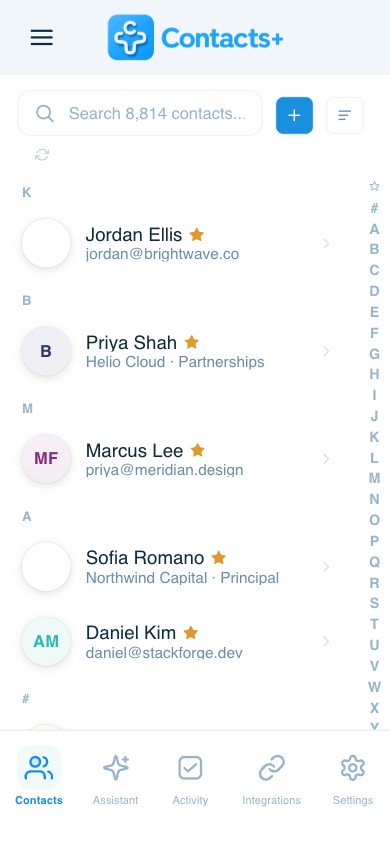
Unifies accounts
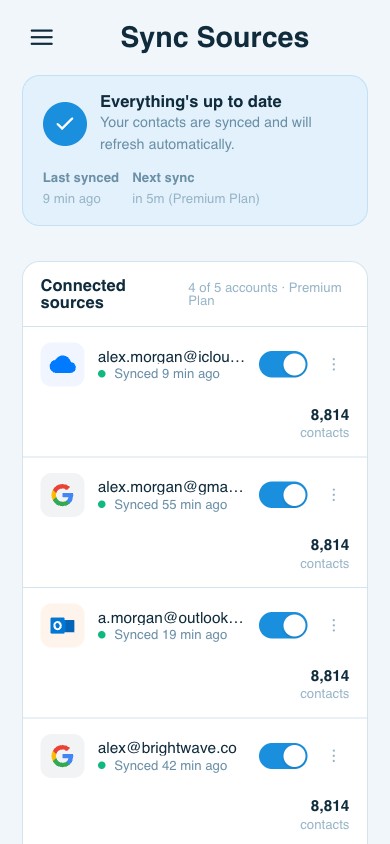
Google, iCloud and Outlook together in one list, with changes flowing back to each. Five accounts on Premium, ten on Teams. See contact sync.
Merges across accounts
Duplicates found across every connected account at once, reviewed field by field. See duplicate cleanup.
Improves on its own
Enrichment adds publicly available detail to thin records. See contact enrichment.
Shares with a team
A shared address book with Owner, Admin and Member roles on Teams. See shared contacts.
Fast capture
Scan a card, or screenshot any page showing contact details. See the business card scanner.
Export whenever
CSV or vCard at any time, on any plan. See exporting contacts.
FAQ
Frequently asked questions
What makes one contact manager better than another?
Mostly how much work it does without you. Anything can store a name and a number. The differences that matter are whether it unifies several accounts, whether it finds and merges duplicates across them, whether records improve on their own, and whether a team can share one list.
Do I need contact management software at all?
Often not. If all your contacts sit in one account, you work alone, and the list is small and tidy, the app on your phone is fine. It becomes worth paying for when contacts are split across accounts, duplicated, or shared with other people.
Should I buy a CRM instead?
If you need to track deals through pipeline stages and forecast revenue, yes, and no contact manager will replace that. Tools like Insightly and Monday.com are built for it. Buying pipeline software to fix messy contact data is the common and expensive mistake.
How do I compare options fairly?
Connect the same real account to each one and see what each finds. Feature lists all look similar; the number of genuine duplicates surfaced from your own address book doesn’t.
Does the free plan tell me anything useful?
Yes, if it starts from your real contacts rather than an empty database. A free tier you have to populate by hand tells you nothing except how much data entry you are willing to do. See what free gets you.
What is the one thing people regret not checking?
Export. People choose on features and discover later that getting their own contact list back out is awkward or impossible. Check it on day one, not when you want to leave.
Run the test on your own contacts.
Connect a real account free and see what it finds. That is the only comparison worth doing.
Start free