
Outlook contacts sync
Outlook contacts sync,
explained properly
Most Outlook sync problems aren’t sync problems at all — they’re storage problems. Contacts kept on one computer have nowhere to go. Here is how to tell the difference, how to get the account syncing, and what to do about Google and iCloud contacts Microsoft will never touch.
At a glance
Only contacts stored in your Outlook or Microsoft 365 mailbox can sync. Contacts held in a local file on one PC stay on that PC, however the account is configured.
- Check Outlook on the web — what you see there is what can sync
- Enable Contacts for the account on each device, not just Mail
- Outlook and Google don’t sync to each other natively
- ContactsPlus connects Outlook, Google and iCloud and keeps them unified
The built-in route
How to get Outlook contacts syncing
Microsoft’s menus have moved several times across classic Outlook, new Outlook and the web, so these steps are about where the contacts live rather than a click path that expires.
Find out where the contacts are stored
Sign in to Outlook on the web with the same account and open the People area. Anything visible there is stored in the mailbox on Microsoft’s servers and can sync. Anything missing is held locally on one computer.
Move local contacts into the account
Contacts kept in a local data file on a Windows PC sync nowhere at all. Move or copy them into the contacts folder belonging to your Outlook.com or Microsoft 365 account — that is the folder devices read.
Add the account to your phone and enable Contacts
Add the Microsoft account in your phone’s account settings, then switch Contacts on for that account specifically. Adding it for mail alone doesn’t bring contacts across.
Confirm on a second device
Add a test contact in Outlook on the web and watch for it on the phone. If it arrives, sync is working — and anything still missing is a storage-location problem, not a sync problem.
Decide how Google and iCloud fit in
Microsoft won’t keep a Google or Apple address book current for you. Exporting a CSV is a one-time snapshot, so if you need those accounts unified rather than copied, you need a layer sitting above all three.
Troubleshooting
Outlook contacts not syncing? Start here
Work down this list in order — the first two account for most cases, and neither needs a reinstall.
They’re stored locally
Contacts in a local data file on one PC have no server copy, so there is nothing for a phone to receive. This is the single biggest cause and the least visible one.
They’re in a secondary folder
Extra contacts folders inside a mailbox often aren’t read by phones, which typically show the main one. Consolidating into the default contacts folder solves it.
Contacts is off for the account
Mail arrives, so the account looks fine. Open the account’s settings on the device and confirm Contacts is enabled, separately from Mail and Calendar.
You’re looking at the wrong account
A personal Outlook.com account and a work Microsoft 365 account are two entirely separate address books, even in the same app on the same device.
Where it runs out
Microsoft keeps Microsoft current, and stops there
Within one Microsoft account this works. Across the accounts most people actually use, it doesn’t attempt to.
No native Google or iCloud sync
Outlook won’t keep a Google or Apple address book up to date. The two systems have no ongoing relationship, whatever the first import looked like.
CSV is a snapshot, not a sync
An export lands once and immediately starts aging. Every later change happens in one place only, and re-importing to catch up creates another round of duplicates.
Duplicates hidden, not merged
Outlook can suppress duplicates from view without combining the underlying records. They are still in the mailbox, and they resurface elsewhere. See duplicate Outlook contacts.
Nothing reconciles conflicting edits
Fix a number in Outlook and the Google copy still has the old one. With no arbitration between providers, both versions survive and you can’t tell which is newer.
The company directory isn’t your contacts
A Microsoft 365 organisation address list is a directory to look colleagues up in. It isn’t your own editable address book and doesn’t follow you if you change jobs.
Work and personal never meet
The people who matter are usually split across a work mailbox and a personal account. Microsoft treats those as strangers, so you keep two half-lists.
The layer above
Outlook, Google and iCloud in one address book
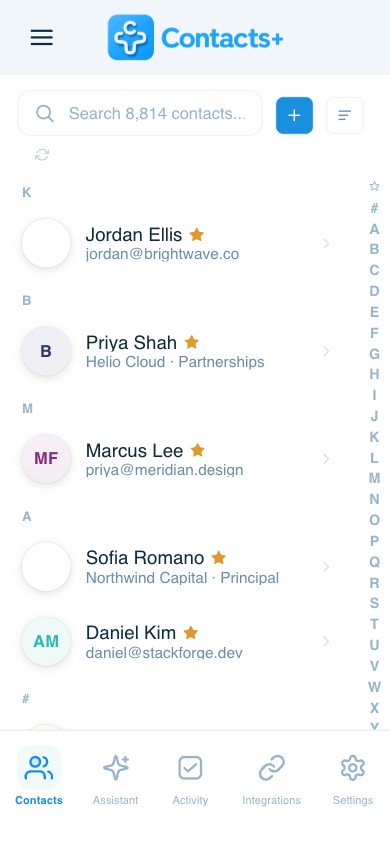
Native sync keeps each account true to itself. ContactsPlus is what makes those accounts add up to a single list.
Accounts connected together
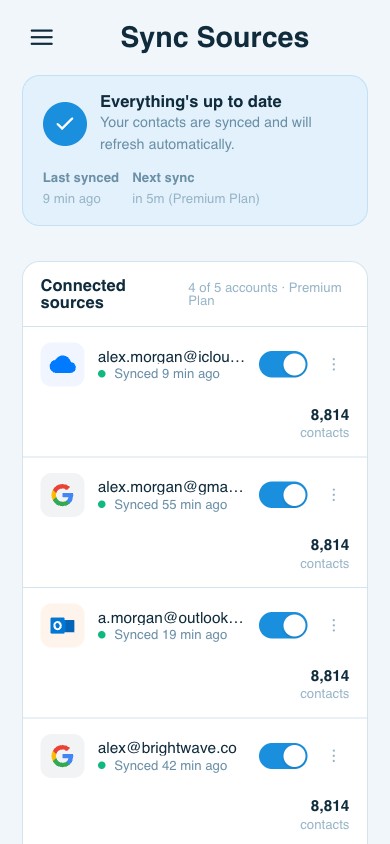
Connect Outlook alongside Google and iCloud and keep them unified, with the sync direction set per account. See how contact sync works.
Duplicates merged across providers
Detection runs across every connected account at once and genuinely combines the records rather than hiding one. See removing duplicate contacts.
Records that improve themselves
Enrichment fills in what nobody typed, business-card scanning adds new people without retyping, and Zapier connects the rest. See contact enrichment.
Room for work and personal
Premium connects five accounts and 25,000 contacts; Teams raises that to ten accounts, unlimited contacts and a shared address book. See pricing.
Syncing something else?
Other places contacts get stuck
The mechanics change with the ecosystem. These cover the rest of the set.
iCloud contacts sync
Why contacts saved to the device never leave it, and where iCloud stops short of Google and Outlook.
Google Contacts sync
Turning it on, fixing contacts that stop syncing, and the Google-to-Outlook gap from the other side.
Sync contacts from iPhone to Mac
The iCloud route between a phone and a desktop, and why a Mac sometimes stays half-full.
Sync contacts from iPhone to iPad
Two Apple devices on one list, and the default save account that decides whether it works.
FAQ
Frequently asked questions
Why are my Outlook contacts not syncing?
The most common reason is that the contacts are stored locally on one computer rather than in the mailbox on Microsoft’s servers — local contacts have nowhere to sync to. The next most common causes are contacts sitting in a secondary contacts folder that devices don’t read, and Contacts not being enabled for that account on the phone.
How do I tell whether my contacts are stored locally?
Sign in to Outlook on the web with the same account and look at the People area. What you see there is what lives in the mailbox and can sync. Anything you can see in the desktop app but not on the web is local to that machine.
Can I sync Outlook contacts with Google?
Not natively, and not in both directions. Microsoft and Google don’t keep each other’s address books current, so the usual workaround is exporting a CSV from one and importing it into the other. That’s a snapshot rather than a sync: it starts going out of date immediately and tends to create duplicates. ContactsPlus connects both accounts and keeps them unified instead.
Does Microsoft 365 sync contacts differently?
The principle is the same. Contacts stored in the mailbox sync to any device signed in to that account, and contacts stored in a local file on one computer don’t. Organisations can also publish a company address list, but that’s a directory to look people up in, not your own editable contacts.
Why do duplicates keep appearing in Outlook?
Usually because the same people arrived twice — from a CSV import and from a connected account — or because more than one account is feeding contacts to the same phone. Outlook can suppress duplicates from view without combining the underlying records, so they are still there.
How does ContactsPlus handle Outlook?
It connects Outlook alongside Google and iCloud and keeps them unified in one address book, with a sync direction chosen per account, duplicate detection across all of them, and export to CSV or vCard whenever you want your data out. Premium connects five accounts and 25,000 contacts; Teams raises that to ten accounts and unlimited contacts. See pricing.
More on Outlook and Microsoft contacts
Work and personal, one list.
Connect Outlook, Google and iCloud and stop maintaining three separate address books.
Start free