
Phone contacts
Where your phone contacts
are actually stored
Your phone shows one list. Behind it sit four or five separate stores — the handset, the SIM, a Google account, an iCloud account, a work account — blended so smoothly that nobody notices until contacts start duplicating or disappearing. Here is how to tell which is which.
At a glance
The contacts on your phone aren’t in one place. They are spread across the device, the SIM card, and whichever Google, iCloud or Outlook accounts the handset is signed in to — displayed as a single list.
- Contacts saved to the device or SIM don’t sync and don’t travel
- The same person in two accounts shows up twice
- Contacts vanish on a new phone when they were never in an account
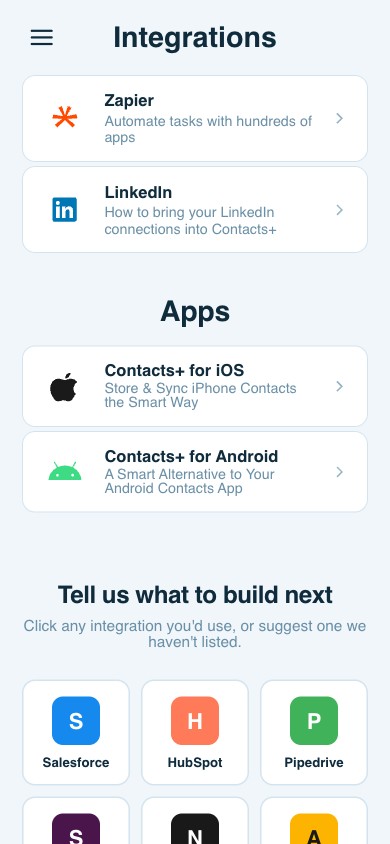
- ContactsPlus connects Google, iCloud and Outlook and unifies them
The five stores
Every place a phone contact can be hiding
Your contacts app merges these into one view. Knowing which store a contact sits in tells you almost everything about how it will behave.
On the handset itself
Saved locally with no account behind it. These don’t sync, aren’t backed up by any provider, and are the most common reason contacts don’t arrive on a new device.
On the SIM card
A holdover from the era before smartphones. Tiny capacity, room for little more than a name and a number, and tied to the SIM rather than to you. Worth checking once, then emptying.
In a Google account
The default on most Android phones and common on iPhones too. These sync, so they reappear on any device you sign in on — and duplicate readily if the same person also exists elsewhere.
In iCloud
The default on iPhone when iCloud Contacts is switched on. Easy to reach from Apple devices, awkward to reach from anything else, which is what makes leaving iPhone feel harder than it is.
In a work Outlook or Exchange account
Added quietly the moment work email is set up. It brings colleagues and sometimes an entire company directory into your personal list, and it disappears the day the job ends.
Inside other apps
Messaging and social apps keep their own directories and push suggestions into the contacts app. Those entries look like real contacts and are a steady source of half-empty records.
The symptoms
Why phone contacts go missing or duplicate
Every one of these is the same fact in a different disguise: there is more than one store, and nothing is reconciling them.
They didn’t survive the new phone
Anything saved to the old device rather than to an account stayed on the old device. See transferring contacts to a new phone for the order to do this in.
The same person appears twice
They exist in two of the stores at once. The phone will usually not merge across providers, so the pair sits there permanently. See removing duplicate contacts.
An account was removed
Sign out of an account and every contact in it leaves with it. Losing a work account can take hundreds of people out of your phone at once.
An edit went to the wrong copy
You fix a number on one version and the other stays wrong. Later the phone offers the stale copy first.
Half the records are nearly empty
A name and a number, no company, no email, no photo. Enrichment fills those gaps from publicly available detail. See contact enrichment.
Nothing is backed up
A contact stored only on the handset has no copy anywhere. See backing up contacts for what an actual safety net looks like.
Step by step
How to find out where your phone contacts are stored
Menu labels move between handsets and versions, so these describe what to look for rather than an exact path.
Open a contact and look for its account label
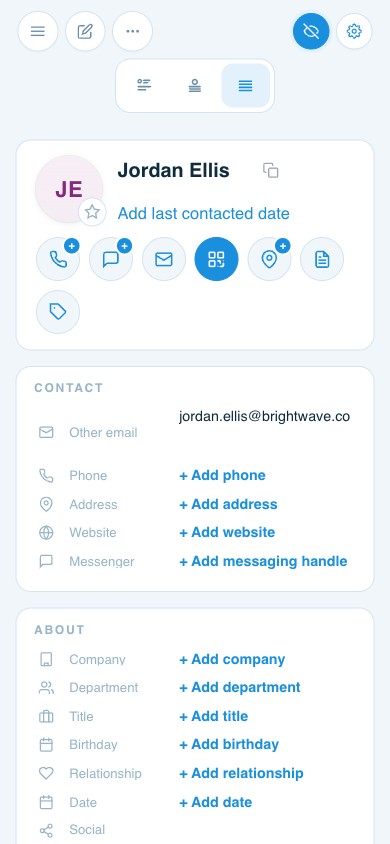
Open a single contact in the phone’s own contacts app and find the line naming the account it belongs to, usually near the top or under an edit or details view. That is the fastest way to see where one person really lives.
Check which accounts the phone is signed in to
In settings, find the accounts section and note every account with contacts switched on. Each one is a separate store, and every one of them is feeding entries into the list you see.
Look for contacts held on the SIM or the device itself
These normally show up under a device or SIM heading in the import and export options. They are the ones that don’t sync anywhere and won’t survive a new phone.
Bring every account into one place
Connect the Google, iCloud and Outlook accounts you found, merge the duplicates that appear once they sit side by side, and work from the single unified list from then on.
The fix that lasts
Stop caring which store a contact is in
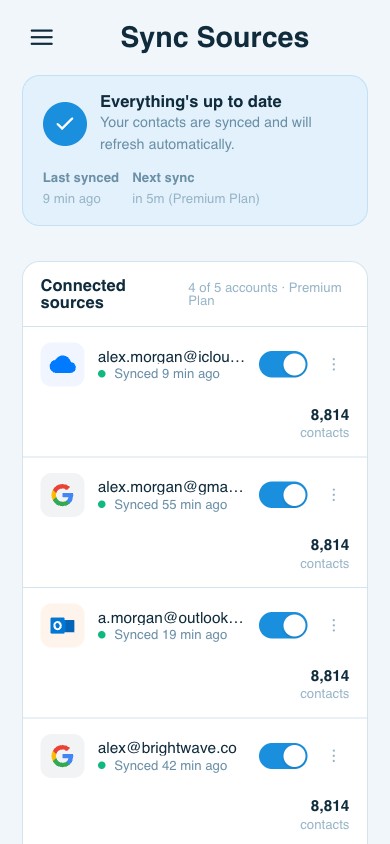
ContactsPlus connects Google, iCloud and Outlook accounts together and keeps them unified, so the question stops mattering. Premium covers up to 5 accounts and 25,000 contacts, contact sync pushes changes back to each, and duplicates are found across all of them at once rather than one account at a time.
Nearby questions
Asking something slightly different?
What a contacts app should do
If the question is about the software rather than the storage — what to expect from a contacts app on iOS, Android and the web.
Building a contact list that stays useful
Once everything is in one place, this covers tagging, cleaning and keeping the list worth having.
Moving to a new phone
The specific task, in order, including the parts that only fail after the old handset has been wiped.
FAQ
Frequently asked questions
Where are phone contacts stored?
In one of five places, and usually several at once: the handset itself, the SIM card, a Google account, an iCloud account, or a work Outlook or Exchange account. The phone shows them blended into a single list, which is why most people assume there is only one store. Which one a contact is in decides whether it syncs, whether it is backed up, and whether it survives the next handset.
Why did my contacts disappear after a new phone or an update?
Almost always because those contacts were saved to the device or the SIM rather than to an account. Account contacts reappear as soon as you sign in on the new handset. Device and SIM contacts have to be moved deliberately, and if nobody moved them they are still on the old phone.
Why do I see the same person two or three times?
Because they exist in more than one of the stores the phone is displaying together. Someone in your Google account and also in iCloud shows up twice, and the phone’s own merging won’t usually reach across providers. Merging them in a tool that can see every account at once is what actually fixes it.
Are contacts saved on the SIM card?
Some can be, and it is worth checking. SIM storage is very limited, holds little more than a name and a number, and belongs to the SIM rather than to you. If anything important is only on the SIM, move it into an account before you change carrier or handset.
Do contacts move between Android and iPhone?
Account contacts do, because the account travels rather than the phone. A Google account signs in on both. iCloud contacts are harder to reach from Android, which is the usual reason a switch feels like starting from nothing. Keeping the address book in a place that isn’t tied to either platform removes the problem permanently.
How do I back up the contacts on my phone?
Get everything into an account first, since a contact saved only to the handset isn’t backed up by anything. From there ContactsPlus keeps a unified copy of every connected account and exports as CSV or vCard whenever you want one you can hold yourself.
Every account. One address book.
Connect Google, iCloud and Outlook and stop wondering where a contact went.
Start free