
Contacts app
What a contacts app should do
that the one on your phone doesn’t
Every phone comes with a contacts app, and for one account on one device it is perfectly adequate. Add a work account, a personal account, a laptop and ten years of accumulated duplicates and it quietly stops coping. This page is about what to expect from a contacts app once you have passed that point.
At a glance
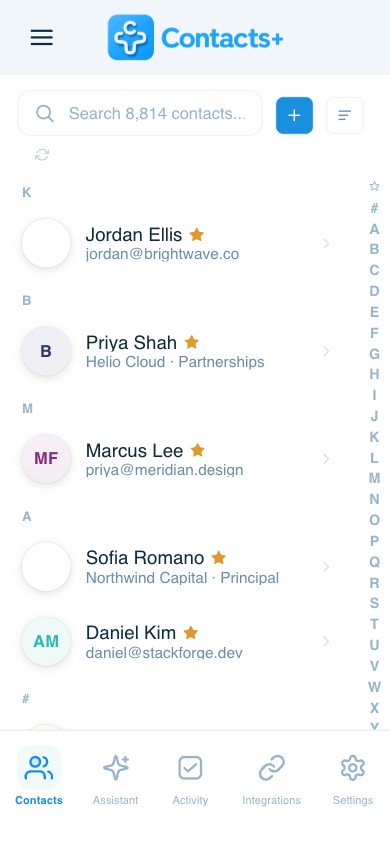
ContactsPlus is a contacts app for iOS, Android and the web that unifies Google, iCloud and Outlook into one address book instead of showing you one list per account.
- One unified list, not a stack of separate account lists
- Duplicates found and merged across every connected account
- Notes, tags, follow-up reminders and files on any contact
- Native iOS and Android apps plus a full web app
The ceiling nobody warns you about
Why the app that came with your phone runs out
The stock contacts app is a viewer. It is very good at displaying what a handset is signed in to, and it was never designed to do anything else.
It shows accounts, not people
Connect three accounts and you get three overlapping lists in one scroll. The app has no opinion about which entry is the real one, because it was never asked to have one.
It won’t clean up after itself
Most built-in apps will merge obvious duplicates inside a single account. Almost none will merge the same person across a Google account and an iCloud account, which is where duplicates actually come from.
There is nowhere to put context
How you met, what was agreed, when to follow up. A phone contact record has fields for numbers and addresses, so everything else ends up in an inbox or a notes app instead.
Adding a contact means typing
You get a card at an event, or a signature in an email, and the only route into the address book is manual entry. Most people never do it, which is why the useful contacts are the ones never saved.
Nothing crosses the ecosystem line
Apple’s app assumes Apple, Google’s assumes Google. If you live in both, and most people do, neither one can show you your whole address book.
It is one device’s view
The list on the handset isn’t the list on the laptop, and the difference between them is invisible until the number you need is on the other one.
The checklist
What a contacts app should actually do
Six capabilities separate a real contact manager app from a list viewer. Judge any candidate, including this one, against them.
Hold more than one account
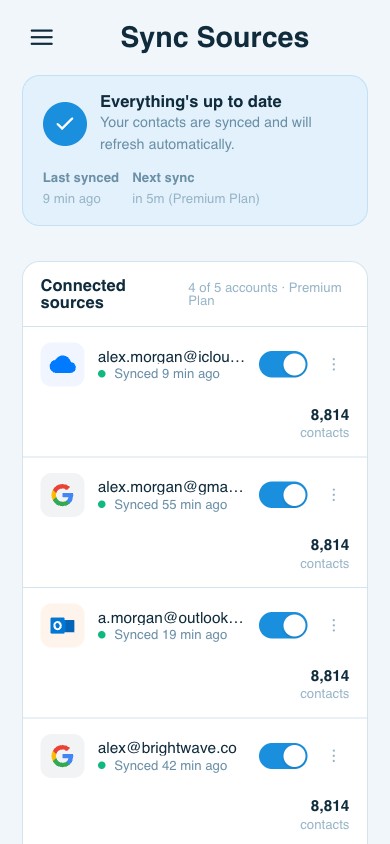
Google, iCloud and Outlook connected together and kept unified, with changes flowing back to each. Premium connects up to 5 accounts and 25,000 contacts. See how contact sync works.
Merge across all of them at once
Duplicate detection that looks across every connected account, with a field-by-field merge so you keep the better value. See removing duplicate contacts.
Fill in what nobody typed
Enrichment adds publicly available detail to thin records, so a name and a mobile number becomes a contact with a company, a title and a photo. See contact enrichment.
Capture without typing
Point a camera at a business card, or feed it a screenshot of anything with contact details on it, and get a structured record rather than a photo. See the business card scanner.
Carry the context
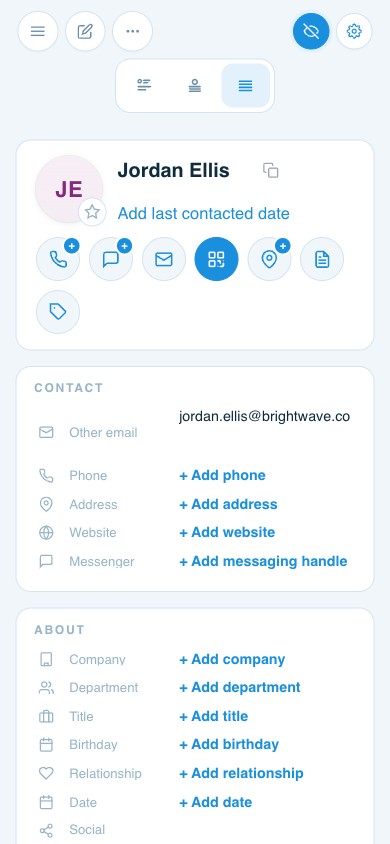
Notes, tags, follow-up reminders and file attachments on any record, so what you know about someone travels with them.
Let you leave
CSV and vCard export on demand, plus Zapier for everything else. An app that manages your address book should never be the reason you can’t move it.
Where you open it
The same address book on every screen
A contacts app is only as good as the device you aren’t holding. These two pages cover each surface in detail.
The mobile apps
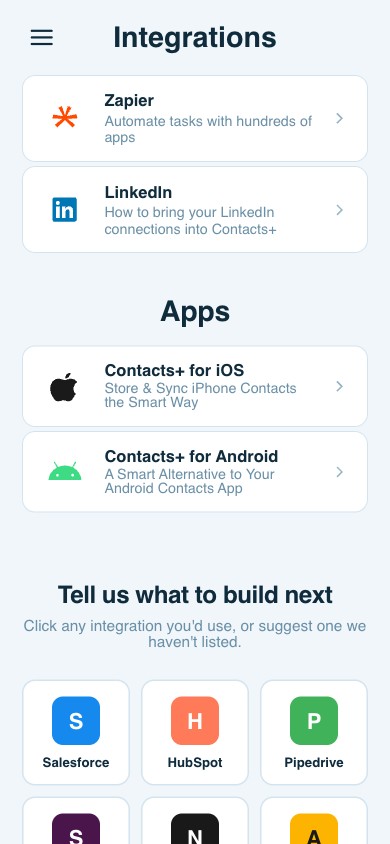
Native iOS and Android apps, including scanning, caller identification and the parts that only make sense with a phone in your hand.
The web app
The full address book in any browser on a laptop, which is where bulk merging, tagging and tidying are far less painful than on a small screen.
One list, not three copies
Whichever you open, you are looking at the same unified address book. An edit on the phone is already there in the browser, and in the connected accounts behind both.
Step by step
How to set up a contacts app
Connect the accounts your contacts already live in
Sign in to the Google, iCloud and Outlook accounts that already hold contacts, so the app starts from everything you have rather than one account or a partial import.
Merge the duplicates first
Everyone who arrived from more than one account is now sitting there twice. Merge field by field before you build anything on top of the list.
Add the context a phone app has nowhere for
Notes, tags, follow-up reminders and attachments on the records that matter, so the reason you know someone lives on the contact and not in an inbox.
Open it everywhere you work
Install the iOS or Android app and use the same address book in a browser, so the list is identical wherever you happen to be.
Nearby questions
Asking something slightly different?
This page is about the software. If your question is about the contacts themselves, start here instead.
Where your phone contacts are stored
Device, SIM, Google, iCloud or Outlook — which one a contact is actually in, and why that decides whether it survives a new handset.
Building a contact list that stays useful
Tagging, cleaning and sharing, once you have the app and the contacts are in one place.
Contact management software
The same category viewed from the desk rather than the phone, including how it differs from a CRM.
FAQ
Frequently asked questions
What is a contacts app?
A contacts app is where your address book lives. Every phone ships with a basic one that displays whichever accounts the handset is signed in to. A dedicated contacts app goes further: it unifies those accounts into a single list, removes the duplicates that having several accounts creates, and adds the notes, tags and reminders a stock app has no field for.
How is this different from the contacts app on my phone?
The built-in app is a viewer for the accounts on that one handset. It shows you each account’s list side by side, it won’t merge duplicates across providers, and anything you write down about a person has nowhere to go. ContactsPlus unifies Google, iCloud and Outlook into one address book, merges duplicates across all of them, and keeps notes, tags, reminders and attachments on the record.
Do I have to stop using Google Contacts or iCloud?
No. ContactsPlus works with those accounts rather than replacing them. Contacts stay where they are, changes flow back to the connected accounts, and the phone’s own app keeps showing them.
Is there one contacts app that works on Android and iPhone?
Yes. ContactsPlus has native iOS and Android apps plus a full web app, all reading the same unified address book. That matters most to people who carry an Android phone and use an iPad, or who change platform every few years and don’t want to rebuild the list each time.
What should I look for in a contact manager app?
Four things separate a real contact manager from a list viewer: it connects more than one account and keeps them unified, it finds and merges duplicates across all of them, it lets you record context such as notes and tags, and it exports cleanly as CSV or vCard so you are never locked in.
Can a contacts app be shared with a team?
On the Teams plan, yes. Everyone works from one shared address book with Owner, Admin and Member roles, and an edit by anyone updates everyone’s view in real time. On personal plans the address book is yours alone.
One app. Every account. One list.
Connect Google, iCloud and Outlook and open the same address book on any device.
Start free