
Shared contacts for Gmail
Shared contacts for Gmail
that everyone actually shares
Google gives you a clean way to hand contacts to someone else, and it is worth knowing. What it doesn’t give you is a list two people can work from at the same time. Here is the built-in route, exactly where it stops, and what to do when a copy is no longer enough.
At a glance
Google Contacts can export contacts for someone else to import — it can’t share a live list. ContactsPlus gives the same team one shared address book instead, so nobody re-sends a file again.
- Native route: select contacts, export as Google CSV or vCard, they import a copy
- The Workspace directory covers colleagues, not customers, and is read-only
- ContactsPlus: anyone’s add or edit updates everyone’s view in real time
- Owner, Admin and Member roles decide who can change what
- Works even when half the team is on iCloud or Outlook
The built-in route
How to share Google contacts from Gmail
Do this first if you just need to hand a set of people to a colleague once. It is free, it takes about two minutes, and it works whether they are on Google or not.
Open Google Contacts on the web
Go to contacts.google.com in a browser, signed in to the account the contacts live in. The desktop layout is the only place with a full export option.
Select the contacts you want to share
Tick them individually, or open a label in the left-hand menu and select everything in it, so you are sharing a defined group rather than your whole address book.
Export them to a file
Use the export option and choose Google CSV for someone moving into Google Contacts, or vCard for someone on Apple or Outlook. You get one file containing the selected people.
Send the file and have them import it
Email or share the file, and they import it into their own Google Contacts. Ask them to import into a new label so it stays separable from what they already have.
Decide how you will handle the next change
They now hold a copy, not a shared list. Either agree who re-exports and when, or move the team onto one shared address book so nobody re-sends anything.
Where it runs out
Why the export never stays true for long
Nothing above is wrong. It is just a hand-off, and a team needs a shared surface.
You sent a snapshot
The file was accurate the second you made it. Every number that changes afterwards changes in your copy and nobody else’s, and there is no signal to tell them they are now wrong.
Labels don’t travel
Labels are personal to your account. The other person receives contacts, not your organisation of them, so the structure you built gets rebuilt — differently — on the other side.
The directory is the wrong list
A Google Workspace directory lists people who have an account in your organisation. It is read-only for ordinary users and it doesn’t hold your customers, suppliers or prospects — which are exactly the contacts a team needs to share.
No roles, no brakes
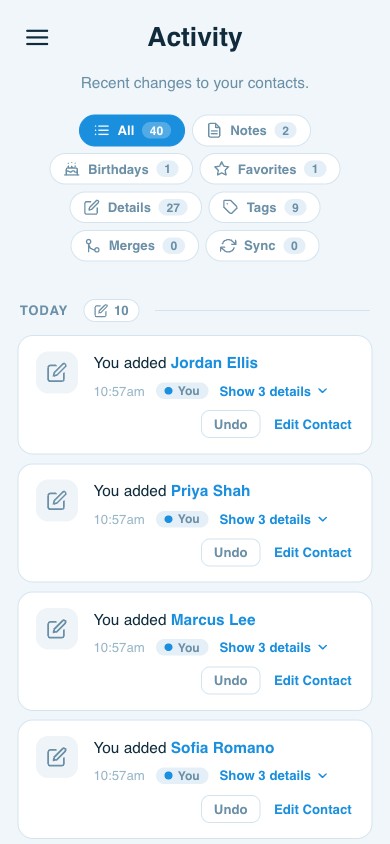
Once the file has left your account you control nothing about it. You can’t make it read-only, can’t take it back, and can’t tell who changed what.
The context stays behind
A CSV carries the phone number but not what was agreed, who owns the relationship, or when anyone last spoke to them. That part stays in your inbox.
You share the duplicates too
Whatever mess is in your account is in the export. Worth merging duplicate Google contacts before anyone else inherits them.
How it works instead
A shared contacts manager, not another file
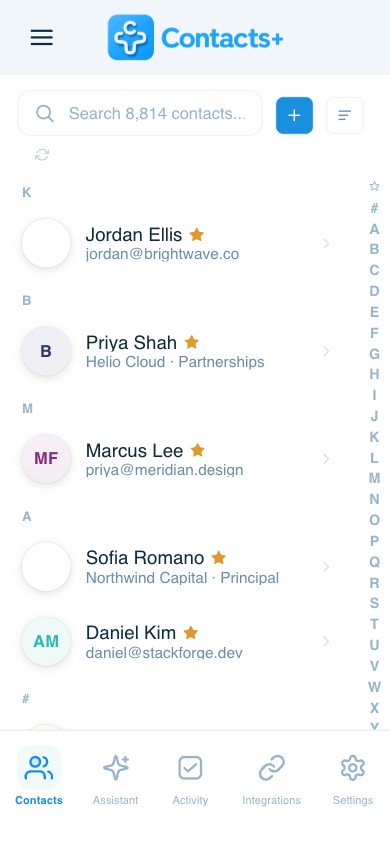
ContactsPlus sits over the Google account you already use, so the shared list is the same contacts — just no longer trapped in one login.
One shared address book
Everyone works from the same contacts. An add or an edit by anyone updates everyone’s view in real time, so there is no re-export and no second version to reconcile.
Roles you control
Owner, Admin and Member roles decide who can manage the team, who can edit shared contacts, and who can only view them. Sharing doesn’t have to mean everyone can change everything.
Shared notes and an owner
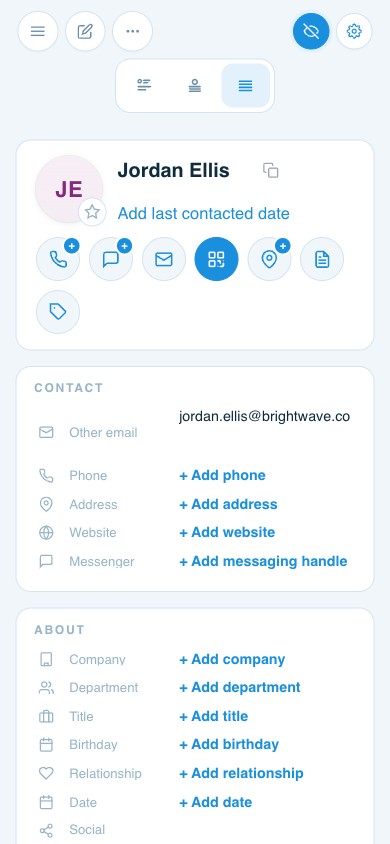
Notes the whole team can see, and an assignable contact owner, so the reason behind a relationship travels with the record instead of sitting in one person’s Gmail.
Not only Gmail
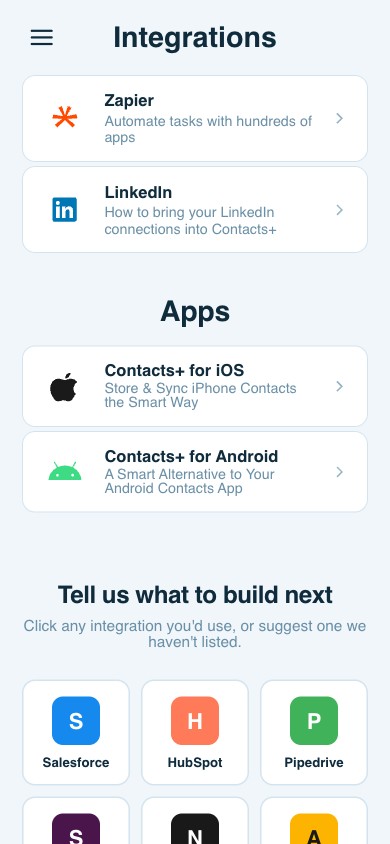
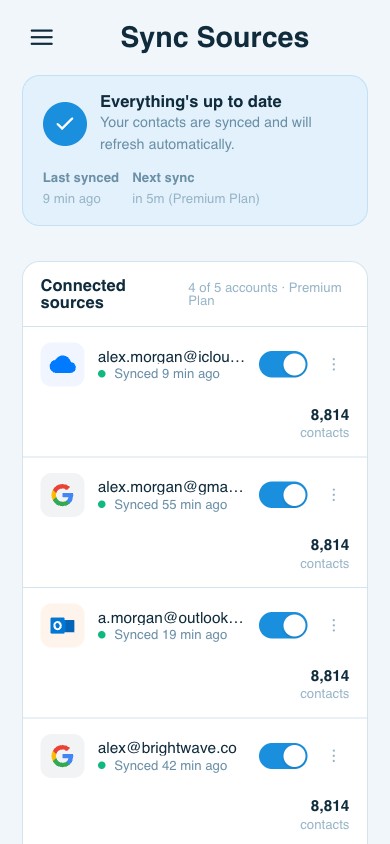
Google, iCloud and Outlook accounts connect together, so the person on a Mac and the person on Microsoft are on the same list. See how contact sync works.
Clean before you share
Duplicate detection and merging first, so the team inherits one record per person. See removing duplicate contacts.
It fills its own gaps
Enrichment adds the details nobody typed, so the shared list improves over time. And you can still take it out at any point — CSV and vCard export are always there. See contact enrichment.
Not everyone is on Gmail
Sharing from somewhere else too?
Most teams are a mix. The mechanics differ by platform, so each one is worth reading on its own.
Share contacts on iPhone
Sharing a contact card, sending several at once, and why AirDrop solves a different problem from a team list.
Share a contact list in Outlook
Sharing a contacts folder in Outlook and Microsoft 365, and what recipients can and can’t do with it.
All the ways to share contacts
The overview: what sharing should mean, why the usual approaches fail, and how a shared address book is different.
Which plan
Shared contacts come with Teams
The shared address book, roles and shared notes are part of ContactsPlus Teams, which adds unlimited contacts and syncs up to 10 accounts, against 5 on Premium. See the full pricing for current plan details.
FAQ
Frequently asked questions
Can I share a Google Contacts label with someone?
Not as a live shared list. Labels are personal to your account. You can select everything in a label and export it, but what the other person receives is a copy of those contacts at that moment, not the label itself — and your later edits never reach them.
Does the Google Workspace directory already share contacts?
It shares colleagues, which is a different thing. The directory lists people who have an account in your organisation, it is read-only for ordinary users, and it doesn’t hold the customers, suppliers and prospects a team actually needs to share. Adding outside people to it is an administrator job rather than something the team can do.
What is the difference between a shared contacts manager and exporting a CSV?
A CSV is a snapshot that starts going out of date the moment you send it. A shared contacts manager is one address book several people are looking at, so an add or an edit by anyone updates everyone’s view in real time and there is nothing to re-send.
Can I stop some people from editing the shared contacts?
Yes. ContactsPlus has Owner, Admin and Member roles, so you decide who can manage the team, who can edit shared contacts, and who can only view them. An exported file gives you no control at all once it has left your account.
Half our team isn’t on Gmail. Does that break it?
No. ContactsPlus connects Google, iCloud and Outlook accounts together, so a team split across providers still works from one shared list. Teams syncs up to 10 accounts and Premium 5.
Should I clean up duplicates before sharing?
Yes. A shared list inherits whatever is already in it, so three versions of the same person becomes everyone’s problem at once. Merge duplicates first, then invite people.
Which plan includes shared contacts?
The shared address book, roles and shared notes are part of ContactsPlus Teams, which also gives unlimited contacts. See the pricing page for current plan details.
Stop exporting. Start sharing.
Give the team one shared address book that stays current by itself — Gmail or not.
Start free