
Comparison
ContactsPlus vs
Shared Contacts for Gmail
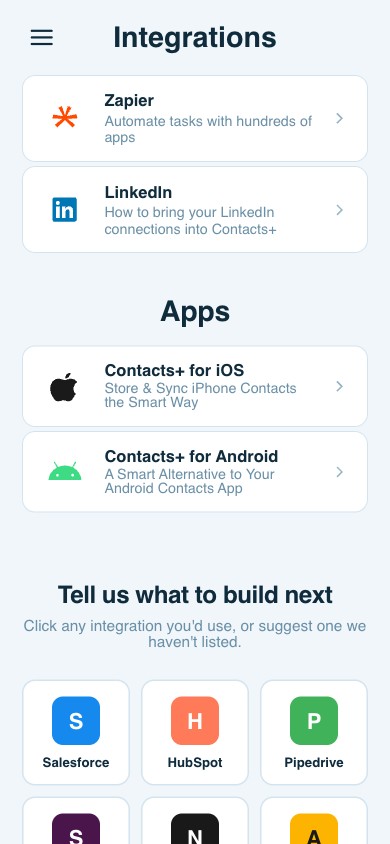
ContactsFlow (formerly Shared Contacts for Gmail) makes Google Contacts the centre of your team’s address book. ContactsPlus doesn’t put any provider the centre — Apple iCloud, Google and Microsoft are all accounts it syncs, two-way, at the same time. That single difference is what the whole comparison below is built on.
ContactsPlus
Three providers, both directions, one shared book.
Result: one shared address book fed by all three providers, with the same person merged into a single record wherever they came from.
ContactsFlow
Google Contacts is the source. Everything else receives.
Result: if a contact doesn’t start life in Google Contacts, the product has no way to reach it. Outlook and phones are places labels land, not accounts it reads.
Every ContactsFlow detail on this page comes from their own pricing, feature and knowledge-base pages, captured in August 2026.
At a glance
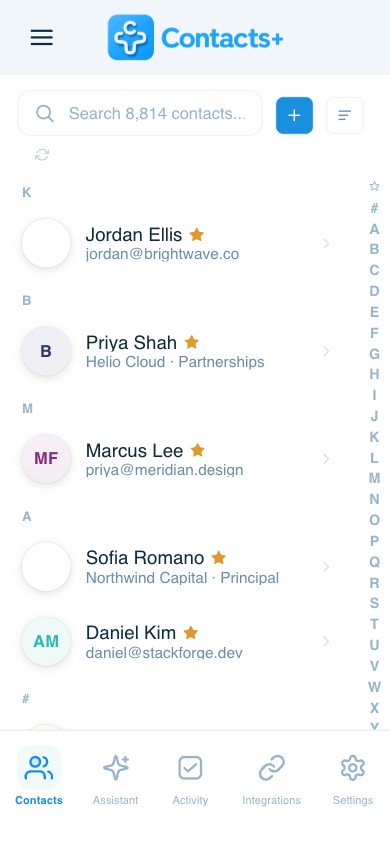
ContactsPlus vs ContactsFlow: across 40 compared features, 25 are available only in ContactsPlus and 15 exist in both. ContactsFlow sits inside Gmail. ContactsPlus is the one that works when your contacts don’t all live in Google.
- Apple iCloud sync — iCloud appears nowhere on the ContactsFlow site
- Microsoft as a two-way source account, not a destination for pushed labels
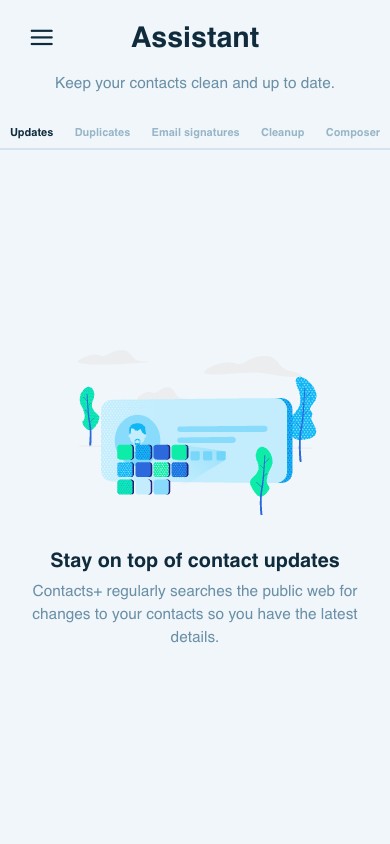
- Duplicate detection, enrichment and cleanup across providers
- iOS and Android apps on every plan, including the free one
- No Google account needed, where theirs is Google sign-in only
The scoreboard
40 features compared
Every capability ContactsPlus ships that ContactsFlow doesn’t, and everything they both do, checked one by one against ContactsFlow’s own published pages. Nothing here isn’t worth reading.
25
Only in ContactsPlus
15
In both products
The core difference
Every account is a source, not a spoke
ContactsPlus treats Apple iCloud, Google and Microsoft as equal sources, each one read from and written back to, with the same person merged into a single record. ContactsFlow is built around Google: Outlook and phones only ever receive shared Google labels, and iCloud appears nowhere.
You choose
Three ways to sync, and you pick for each account
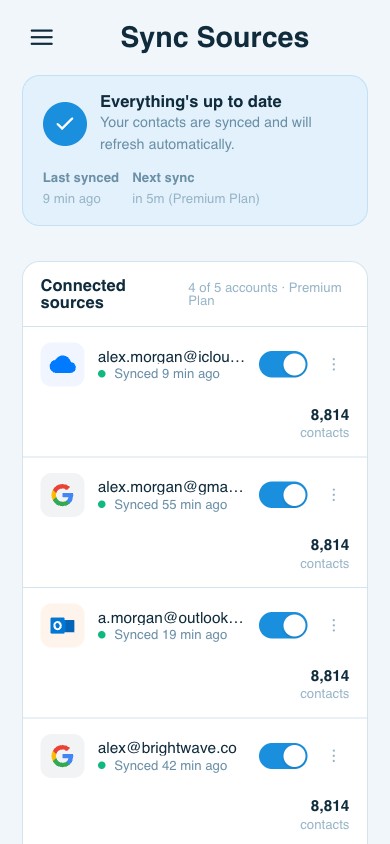
Not every account should behave the same way. A work Google account might need to stay identical in both places, while an old iCloud account should only ever be read. ContactsPlus lets you set the direction on each account separately, change it whenever you like, and it applies in real time on Premium and Teams. More on how sync works.
Two-way sync
Your account and ContactsPlus stay perfect copies of each other. Every add, edit and delete flows both ways, for Apple iCloud, Google and Microsoft alike.
Pull contacts in
One-way, into ContactsPlus. It only reads, so your source account is never changed. It’s the lightest and fastest option.
Push contacts out
One-way, outward. ContactsPlus pushes your cleaned-up master list to an account, and is never changed by it. This third direction is the only one ContactsFlow offers beyond Google.
Beyond a clean address book
Four things ContactsPlus does that most tools leave to you
Getting the contacts right is the start. These are the four that save the most time afterwards.
Email signatures, read for you
ContactsPlus reads the signature block on mail you already receive and fills in the job title, company and direct line by itself. Nothing to copy, nothing to type. The records just get better while you work. Premium and Teams.
Tasks that reach your calendar
Give a follow-up a due date and time and it turns up in your calendar, whether that’s Google, Outlook or Apple. Snooze it, filter a long list down to today, and start each morning with a digest of what is due.
Team tasks, with real permissions
Put a task in a shared address book and it becomes the team’s. Assign it to a colleague, control who can act on it, and see who closed it and when. Everyone works the same list instead of chasing each other. Teams.
One document, many contacts
Attach a contract, proposal or scan to the person it belongs to, and to everyone else involved. Link one file to as many contacts as you like: it’s stored once and counted once against your storage, however many people it sits on. On every plan, team or not.
The full matrix
Every feature, side by side
Where a ContactsPlus feature needs a paid plan, we name the plan rather than quietly implying it’s included.
| Feature | ContactsPlus | ContactsFlow |
|---|---|---|
| Sync & accounts | ||
| Apple iCloud syncOnly usNative two-way sync on every plan. Apple iCloud doesn’t appear anywhere on the ContactsFlow site. | ✓ | — |
| Google Contacts syncTwo-way in both products. ContactsFlow: all plans. | ✓ | ✓ |
| Microsoft / Outlook as a synced sourceOnly usContactsFlow treats Outlook as a destination for shared Google labels; its only Outlook article is a migration guide out of Google. | ✓ | — |
| All three providers in one address bookOnly usiCloud, Google and Microsoft kept two-way at the same time, with no provider as the hub | ✓ | — |
| Choose the sync direction per accountOnly usTwo-way, pull in, or push out, set per account and changeable any time | ✓ | — |
| Push a shared list out to phones and OutlookThe one direction both products cover. ContactsFlow: all plans. | ✓ | ✓ |
| Sync as changes happenContactsPlus: Quick sync on Premium & Teams, daily on Free. ContactsFlow: instant sync of Google Contacts edits needs their Chrome extension, Business & Corporate. | ✓ | ✓ |
| CSV & vCard import and exportOnly usOn every plan including Free. Not documented anywhere on ContactsFlow’s site. | ✓ | — |
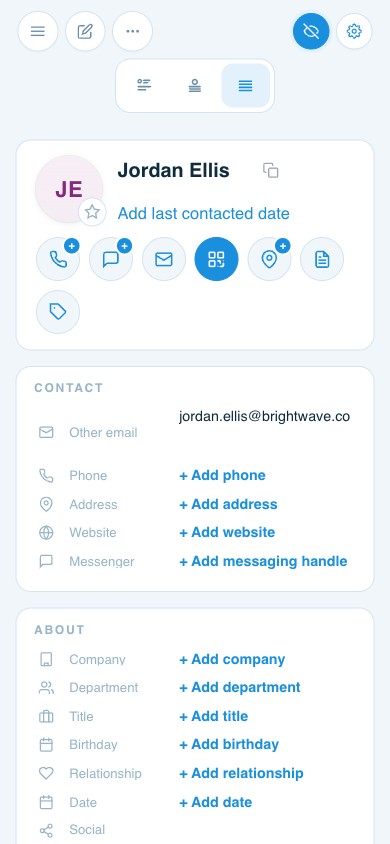
| Works without a Google accountOnly usRun ContactsPlus on Apple or Microsoft alone. Every ContactsFlow entry point is “Continue with Google”. | ✓ | — |
| Sharing with a team | ||
| Shared address bookContactsPlus: Teams, up to 50 members. ContactsFlow: all plans. | ✓ | ✓ |
| Roles and permission managementOurs: Owner, Admin, Member. Theirs: view, modify, delete or reshare, per list. | ✓ | ✓ |
| Shared notes and a contact owner per recordOnly usTeams. ContactsFlow transfers ownership of a whole list, not of one contact. | ✓ | — |
| Cleaning up contact data | ||
| Duplicate detection & mergeContactsPlus: Premium & Teams. ContactsFlow: duplicates auto-removal inside Google Contacts, all plans. | ✓ | ✓ |
| Merge duplicates held in different providersOnly usThe same person in Gmail, iCloud and Outlook, merged into one record. Theirs only reconciles within Google. | ✓ | — |
| Contact enrichmentOnly usPremium & Teams | ✓ | — |
| Profile photo matchingOnly usPremium & Teams | ✓ | — |
| Outdated-data cleanupOnly usFlags contacts whose details have gone stale, on Premium and Teams | ✓ | — |
| Email signature extraction (Gmail)Only usPulls names, titles and numbers out of signatures, on Premium and Teams | ✓ | — |
| The contact record | ||
| Emails, phone numbers & addressesAdd as many as you need per contact | ✓ | ✓ |
| Job title, company & department | ✓ | ✓ |
| Custom fieldsContactsFlow: Business & Corporate | ✓ | ✓ |
| Tags or labelsOurs are tags; theirs are Google Contacts labels | ✓ | ✓ |
| Notes on a contact | ✓ | ✓ |
| Dated note historyOnly usA running history on the record, not one free-text box | ✓ | — |
| RelationshipsOnly usLink family, colleagues & referrals | ✓ | — |
| Capturing contacts | ||
| Business card scanningContactsPlus: 100 cards a month on Premium & Teams, in the app and on the web. ContactsFlow: photo of a card in the mobile app, which starts at their Business plan. | ✓ | ✓ |
| Follow-ups & tasks | ||
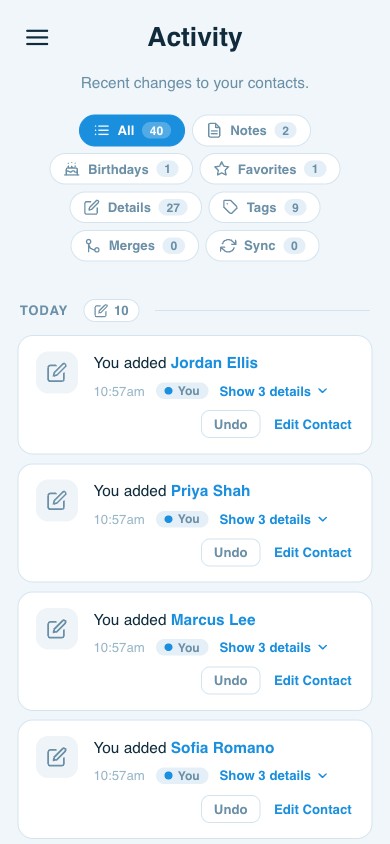
| Tasks and follow-up reminders on a contactOnly usDue dates and times, on every plan including Free. Nothing equivalent on ContactsFlow’s site. | ✓ | — |
| Snooze and reschedule a taskOnly usA human-friendly snooze on every task | ✓ | — |
| Daily task digest emailOnly usEvery plan, including Free | ✓ | — |
| Push follow-ups to your calendarOnly usOne-way push to Google, Outlook & Apple calendars | ✓ | — |
| Shared team tasks with assignment & permissionsOnly usTeams | ✓ | — |
| Branded task activity reportsOnly usPDF or CSV, on Premium and Teams | ✓ | — |
| Documents on the contact record | ||
| Attach files to a contactOnly us5 MB per file on Free, 10 GB of storage on Premium. Not documented anywhere on ContactsFlow’s site. | ✓ | — |
| A library of every file, across all contactsOnly usAnswers “where is that quote?” when you can’t remember whose record it’s on | ✓ | — |
| Virus scanning on uploadOnly usFlagged files quarantined, not silently deleted | ✓ | — |
| 30-day Trash for deleted filesOnly usRestore a file, or empty Trash to reclaim space | ✓ | — |
| Admin & platform | ||
| Apps & plans | ||
| Web app | ✓ | ✓ |
| iOS appContactsPlus: every plan, including Free. ContactsFlow: Business plan and up. | ✓ | ✓ |
| Android appContactsPlus: every plan, including Free. ContactsFlow: Business plan and up. | ✓ | ✓ |
| Free forever planOnly us1,000 contacts, one synced account and the full contact record. ContactsFlow offers a free trial only. | ✓ | — |
A dash means the capability is either not offered or not documented anywhere on the other product’s own site. All ContactsFlow entries were taken from their published pricing, feature and knowledge-base pages in August 2026. Their plans are theirs to change — check their pricing page before you decide, and ours too.
The honest answer
Which one should your team buy?
These aren’t the same product sold at two prices. They answer different questions, and the right one depends on where your contacts come from, not on which feature list is longer.
Choose ContactsFlow if…
- Your whole team is on Google Workspace and intends to stay there.
- What you mainly need is shared labels visible inside Gmail, where people already work, with no second app to learn.
- Everything your team touches already lives in Google Workspace, and you want it to stay there.
- You need Global Address List sync to phones and IP desk phones, or field-level permissions on shared contacts.
Choose ContactsPlus if…
- Contacts arrive from more than one place, and they usually do.
- Anyone on the team works from an iPhone address book or a Microsoft account as their source of truth.
- The shared book needs deduplicating, enriching and following up on, not just sharing.
- You want to try it before anyone pays: the free plan is free forever, and the mobile apps are on it.
Moving over
How to move from ContactsFlow
There is no migration project here, and that’s a direct consequence of how their product works: your contacts never left Google in the first place.
1. Export nothing
Because ContactsFlow shares Google Contacts labels rather than storing a separate copy, your contacts are already sitting in Google. Nothing has to be exported or migrated, which also means the move is reversible at any point.
2. Connect the same Google accounts
Sign in to ContactsPlus and connect the same Google Workspace accounts. Contacts flow in directly, with names, numbers, addresses and photos, and no file handling at all. More on how sync works.
3. Add the accounts they could not reach
Now connect the iCloud and Microsoft accounts. Those are the ones a Google-hub product has no way to read. They join the same list rather than sitting beside it.
4. Clean up, then share
Pulling several sources together surfaces duplicates. Run duplicate detection across the merged set, let enrichment fill the gaps, then set the team up on the shared address book with Owner, Admin and Member roles.
Nothing is moved out of Google, Microsoft or Apple. ContactsPlus syncs with them. Gmail autocomplete keeps working, your iPhone keeps showing your contacts, and if you disconnect later, every source account is exactly where you left it.
Questions
Frequently asked questions
What is the main difference between ContactsPlus and ContactsFlow (formerly Shared Contacts for Gmail)?
Where the address book lives. ContactsFlow makes Google Contacts the centre of your team’s address book. It shares Google Contacts labels and manages permissions on them, and its two-way sync is two-way with Google. ContactsPlus makes no provider the centre: Apple iCloud, Google and Microsoft are all accounts it syncs, two-way, at the same time.
Can ContactsPlus sync my iPhone contacts?
No. Apple iCloud doesn’t appear anywhere on their site. An iPhone shows up only as a device that receives shared Google labels, never as an account they read contacts from. ContactsPlus syncs iCloud two-way, alongside Google and Microsoft, on every plan.
Does ContactsPlus treat Outlook as a full source?
No, only as a destination. Their own knowledge base describes it the other way round: “Shared contacts can be synchronized with the collaborator’s mobile devices and Outlook contacts.” Their only Outlook article is a migration guide for moving Google Contacts into Outlook. ContactsPlus treats a Microsoft account as a full two-way sync source.
Are the ContactsPlus mobile apps on every plan?
No. Their own plan matrix puts the Android and iOS apps on their Business plan and above. Their entry Team plan carries five capabilities only: Google Contacts sharing, sharing permission management, two-way synchronization with Google Contacts, duplicates auto-removal, and sync with Outlook or mobile phones. ContactsPlus includes the iOS and Android apps on every plan, including the free one.
Do I need a Google account to use ContactsPlus?
No. You can run ContactsPlus with only an Apple iCloud account, only a Microsoft account, or any combination. Every ContactsFlow entry point is “Continue with Google” or “Sign in with Google”, so a Google account is a precondition there.
What can ContactsPlus do that ContactsFlow can’t?
Twenty-five of the fifty-five compared capabilities, including Apple iCloud sync, Microsoft as a two-way source account, per-account sync direction, merging duplicates held in different providers, contact enrichment, profile photo matching, outdated-data cleanup, Gmail email-signature extraction, relationships, dated note history, tasks and follow-up reminders with snooze and a daily digest, shared team tasks, branded task activity reports, documents on the contact record with a cross-contact library, virus scanning and a 30-day trash, and a free forever plan.
How do I move from ContactsFlow to ContactsPlus?
There is nothing to export. Your contacts live in Google Contacts, so you connect the same Google Workspace accounts to ContactsPlus and they flow in directly. Then add the iCloud and Microsoft accounts ContactsFlow could never read, run duplicate detection across the merged set, and set the team up on the shared address book with roles.
One address book. Every account.
Apple iCloud, Google and Microsoft in one list, with the duplicates gone. Free to start, no card needed.
Try ContactsPlus free