
What Your Contact List Says About You (and Your Business Habits)

Your contact list might seem like just a collection of names, emails, and phone numbers, but it’s a digital reflection of how you operate as a professional—and maybe even as a person. Are you methodical and tidy, or do you operate in a state of glorious chaos? Do you collect connections like baseball cards or add people when necessary?
From the hyper-organized executive to the spontaneous networker, your contact list reveals more about your business style than you might think. Below, we break down contact management personalities into fun categories. Chances are you’ll find yourself, or someone you know, in one of them.
1. The Rolodex Royalty 👑
Personality: The Organized Networker
You treat your contact list like a well-oiled machine. Everyone has a label. Notes are detailed. Birthdays are logged. You’ve even got tags for “met at 2023 trade show” or “referral from Jane D.” When someone needs a connection, you’re the first one they call. You don’t just know people—you remember them, and your CRM is a thing of beauty.
Business habits:
- You plan ahead.
- You follow up consistently.
- You value systems and workflows.
- You’re probably automating things like a pro.
Strengths: Building long-term relationships, excellent follow-through, and scalability.
Weaknesses: You may spend too much time organizing and not enough time improvising.
2. The Inbox Hoarder 📥
Personality: The Overwhelmed Opportunist
Your contact list is thousands of entries long, and you couldn’t tell who 70% of them are. Every form fill, every event scan, every “let’s connect” on LinkedIn has led to another name in the pile. You mean well, but you’re too busy to clean it up. Somewhere in there might be a golden lead, but finding it feels like a digital episode of Hoarders.
Business habits:
- You say yes a lot.
- You gather more than you sort.
- You chase volume over value.
Strengths: You have a huge network and are always open to opportunities.
Weaknesses: Missed follow-ups, confusion, wasted time sifting through data clutter.
3. The Minimalist Connector 🧘
Personality: The Intentional Introvert
You only add someone to your list if you’ve interacted meaningfully. Your list is short, curated, and deeply intentional. Every person on there matters to you. You’re not into “spray and pray” outreach. You’d rather send five tailored emails than a hundred templates.
Business habits:
- You prefer depth over breadth.
- You’re deliberate with your time and energy.
- You value privacy and meaningful conversation.
Strengths: High engagement rates, genuine relationships, focused networking.
Weaknesses: Limited reach, may miss out on new opportunities or connections.
4. The Ghost of Contacts Past 👻
Personality: The Forgetful Friend
You add people and forget about them. You might have the same person listed three times—once with their work email, once with their personal email, and once with a nickname you forgot you used. You know you should organize your contacts, but it’s never at the top of your list. Every time you open your list, you feel a low-level stress.
Business habits:
- You’re reactive, not proactive.
- You don’t follow up regularly.
- You might lose out on second chances simply by forgetting.
Strengths: You’re personable and easygoing, and people generally like you.
Weaknesses: Inconsistency, lack of system, lost leads, and missed connections.
5. The Social Butterfly 🦋
Personality: The Serial Networker
You’re at every event, online or in person. You’re the one who says, “Let’s connect!” before a conversation ends. Your contact list comprises professionals from various industries, time zones, and job functions. You may not remember everyone, but you’ve created a powerful web of potential connections. You live for the follow-up coffee or DM.
Business habits:
- You prioritize relationships.
- You love connecting others.
- You thrive in social settings, whether digital or face-to-face.
Strengths: Endless opportunities, diverse network, fast-growing reach.
Weaknesses: Lack of depth, high maintenance, and contact fatigue.
6. The DIY Data Scientist 📊
Personality: The Analytical Architect
You don’t just keep contacts—you study them. You track interaction history and tag engagement levels, and likely have your custom contact scoring formula. Your list is segmented to the extreme, and you can pull up a list of “tech founders in Chicago who opened my last two emails” in under five seconds.
Business habits:
- You make data-driven decisions.
- You segment and personalize with precision.
- You love tools, integrations, and dashboards.
Strengths: Exceptional targeting, high efficiency, measurable results.
Weaknesses: Risk of analysis paralysis, sometimes loses the human touch.
7. The Vanishing Act 🎩
Personality: The Reluctant Contact Keeper
You barely keep a contact list at all. Your business habits are mostly memory-based, or stored in whatever platform you happen to be using. Google Contacts? A little. Your inbox? Maybe. You’ve never synced anything. You’re relying on luck and familiarity, and when someone asks for a number, you’re scrolling through emails hoping to find it.
Business habits:
- You work in the moment.
- You don’t rely on systems.
- You might miss opportunities because you don’t log them.
Strengths: You’re scrappy and flexible, with strong short-term memory.
Weaknesses: You lack consistency, and your network isn’t working for you over time.
Most of These Are Storage Problems, Not Personality Problems
Here’s the uncomfortable part: at least three of the types above aren’t character traits at all. They’re side effects of where contacts get saved.
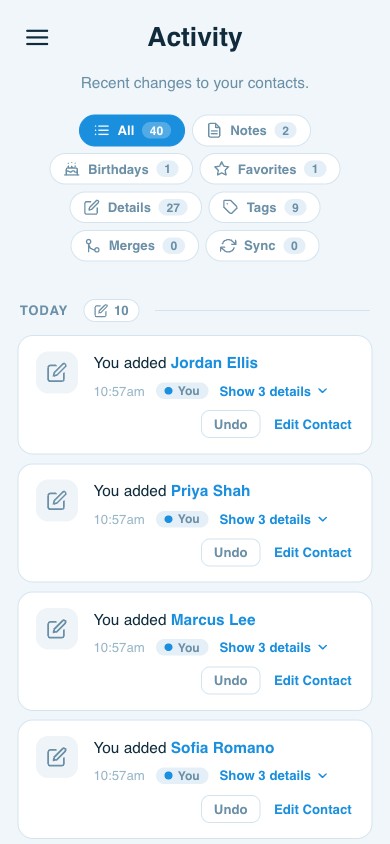
The Ghost with the same person listed three times didn’t forget anything. Gmail saved that person automatically the first time they replied to an email. The phone saved them again when they called. A CSV import from an event added a third copy under a nickname. Three systems each did exactly what they were built to do, and nobody chose the outcome. Merging those duplicates field by field — keeping the work email from one copy and the mobile number from another — is what makes notes and follow-ups stick to a person instead of scattering across copies of them.
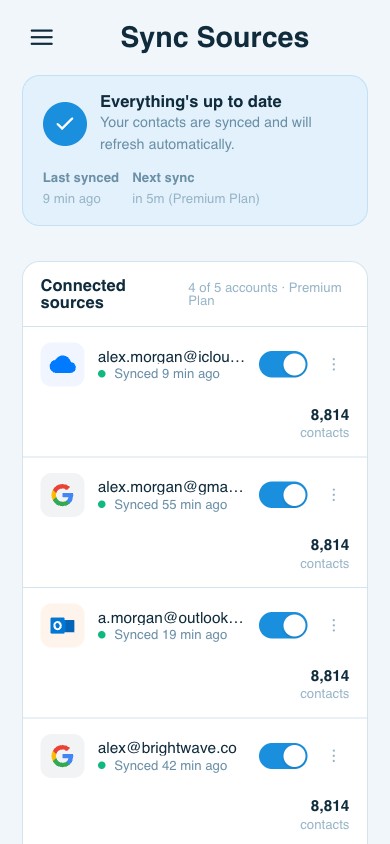
The Vanishing Act usually does have contact lists. Several of them, in places that never announce themselves: phone contacts can sit on the handset itself, on the SIM card, in a Google account, in iCloud, or in a work Exchange profile, and none of those is visible from the others. That isn’t a lack of system. That’s six drawers with no labels.
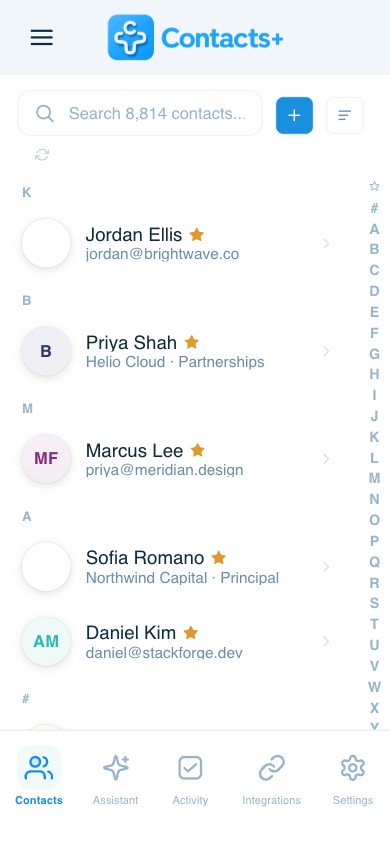
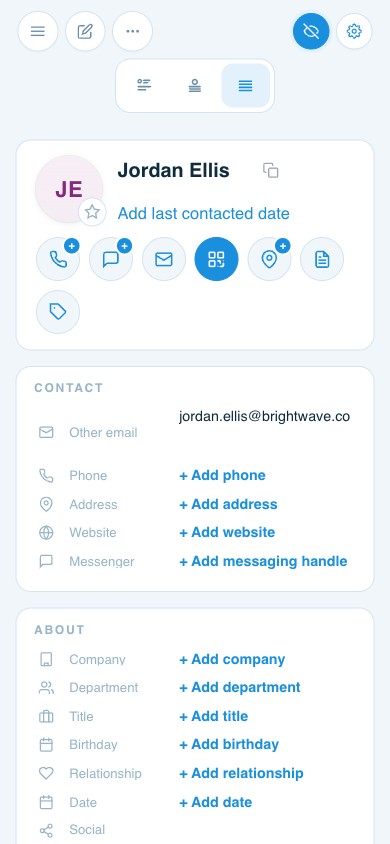
And the Inbox Hoarder’s real problem isn’t volume — it’s that most of those thousands of entries are a name and an email address with nothing attached. No job title, no company, no photo. That is precisely why so many of them are unrecognizable: there is nothing on the record to recognize. Filling those blanks in automatically, rather than by hand, is what contact enrichment is for.
So… What Does It All Mean?
Your contact list style reflects how you approach relationships, business opportunities, and organization. It’s not about being perfect—it’s about understanding your tendencies and how to improve or leverage them.
- If you’re a Rolodex Royalty, lean into leadership by teaching others your systems.
- If you’re an Inbox Hoarder, it might be time to declutter and tag.
- If you’re a Minimalist Connector, try branching out with light-touch outreach tools.
- If you’re a Ghost, merge your duplicates first, then set follow-up reminders on the records that survive.
- If you’re a Butterfly, consider adding segmentation tools to your routine.
- If you’re a Data Scientist, don’t forget the personal touches.
- If you’re a Vanishing Act, start by centralizing your contacts in one place.
Whether you’re just starting to build or have thousands of names under your belt, the goal is the same: make it easier to nurture meaningful, mutually beneficial relationships. Most of the way there is unglamorous plumbing — one record per person, in one place, with enough on it to jog your memory.
So… which one are you?
Related articles
From ContactsPlusSet follow-up reminders on any contact, so nobody goes coldSee Follow-Up Reminders →

Put your contacts to work
Sync, enrich, and clean your entire address book with ContactsPlus — free to start.
Sign up free ← Back to all articles